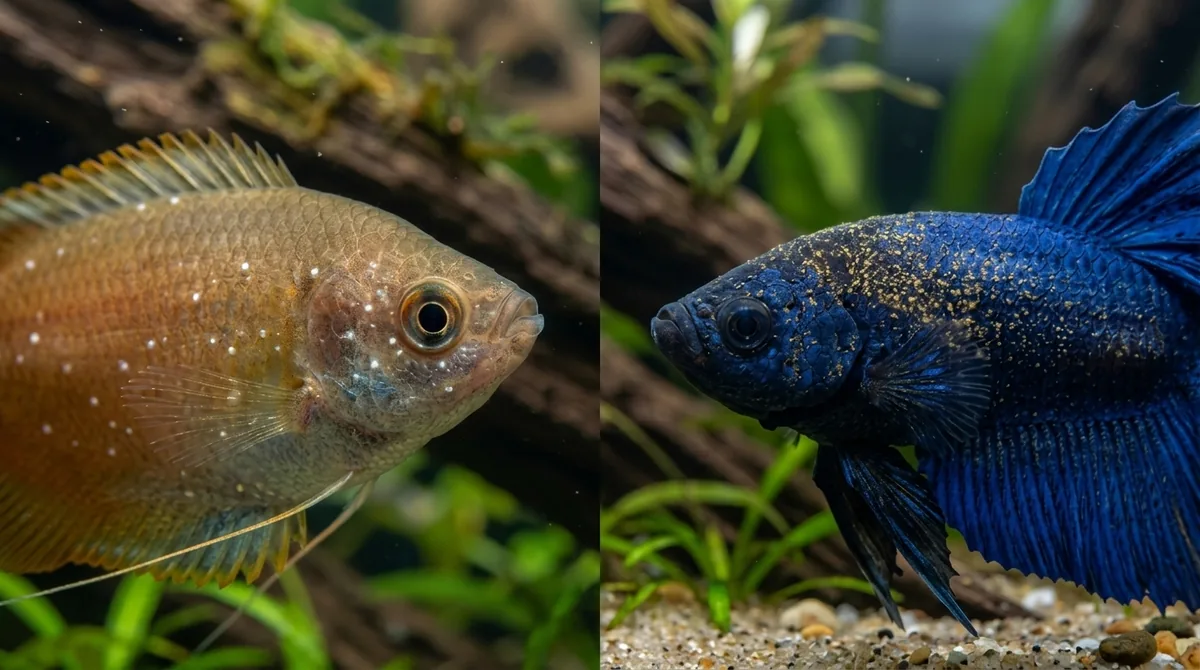
Ich or Velvet?
Two diseases that look almost the same, and treat completely differently.
A fish develops small spots or a dusty coating almost overnight, and the two most common explanations — ich and velvet — can look confusingly similar from a normal viewing distance.
This guide explains how to tell them apart with a simple flashlight check, why treating the wrong one wastes time the fish doesn't have, and how to treat whichever one you're actually looking at.
Spots, or dust —
the difference is easy to miss.
Ich (white spot disease) and velvet both cause a fish's skin to look abnormal within a day or two. Both diseases also tend to trigger flashing and scratching against decor. At a glance, from across the room, they can be hard to tell apart.
Fish with either disease usually breathe a little heavier than normal, since both parasites can irritate the gills alongside the skin. That symptom alone doesn't distinguish them either.
The two diseases need genuinely different medications. A treatment aimed at the wrong one delays the fish getting the right one, while adding an unnecessary chemical load to the tank in the meantime.
If it's been a while since you've seen either disease, look closely before reaching for a bottle. The visual difference is real and checkable in a couple of minutes — it just isn't obvious from a normal glance across the tank.
One is salt grains.
The other is dust.
Ich. Ich produces distinct, raised white spots about the size of a grain of salt. Each spot is separate from the others. You can usually count individual spots even when there are many of them.
Velvet. Velvet produces a much finer coating, closer to a dusting of gold or rust-coloured powder than individual spots. Under normal room lighting it can be easy to miss entirely, or mistaken for a slightly dull, off-colour fish.
The clearest way to tell them apart is a flashlight test. Turn off the tank and room lights, then shine a flashlight across the fish at a low, near-parallel angle. Ich stays as discrete white bumps under this light. Velvet lights up as a fine, shimmering gold-dust film across the whole body.
"Ich is a scattering of individual spots. Velvet is a coating. That distinction is the whole diagnosis, and it takes about two minutes with a flashlight to check."
Confirm with light
before you confirm with medication.
Run the flashlight test in a darkened room before doing anything else. It's the single most reliable way to tell these two apart, and it costs nothing but a couple of minutes.
Note how laboured the breathing is. Velvet tends to hit the gills harder than ich does, so noticeably heavier or faster gill movement leans slightly toward velvet, even before the flashlight confirms it.
Both parasites move through a cycle of attaching to the fish, dropping off to reproduce, and releasing a free-swimming stage that has to find a new fish — and both speed up or slow down with temperature. What differs is the specific pace and treatment window for each species, not whether temperature matters at all, which is part of why a treatment timed for one doesn't reliably work on the other.
Isolating the affected fish, where possible, limits medication exposure for the rest of the tank and makes it easier to observe how the spots or dust respond to treatment day by day.
Treat the one
you actually confirmed.
If the flashlight test shows discrete white spots, treat for ich specifically. A gradual, species-safe temperature increase speeds up the parasite's life cycle, and ich medication needs to run for the full treatment course, not just until the spots disappear.
If the flashlight test shows a gold-dust sheen, treat for velvet specifically, usually with a copper-based or velvet-targeted medication. Dimming the tank lights during treatment also helps, since the parasite responsible for velvet relies partly on light.
Either way, finish the full course of treatment rather than stopping once the visible symptoms clear. Both parasites have life-cycle stages that survive in the substrate or on decor even after the fish looks better. Stopping early is one of the more common reasons either disease appears to "come back."
"The spots were never the whole story. Which parasite they belong to is — and that's the one thing worth confirming before anything else."
- Nowak, B. F., & LaPatra, S. E. (2015). Epizootiology of Ichthyophthirius multifiliis infections in fish: A review. Journal of Fish Diseases, 38(2), 97–109.
- Shinn, A. P., et al. (2015). Ichthyophthirius multifiliis (white spot) infections in fish. Southern Regional Aquaculture Center Publication No. 476.