Ich Keeps
Coming Back
Treating ich is not the same as understanding why it keeps returning.
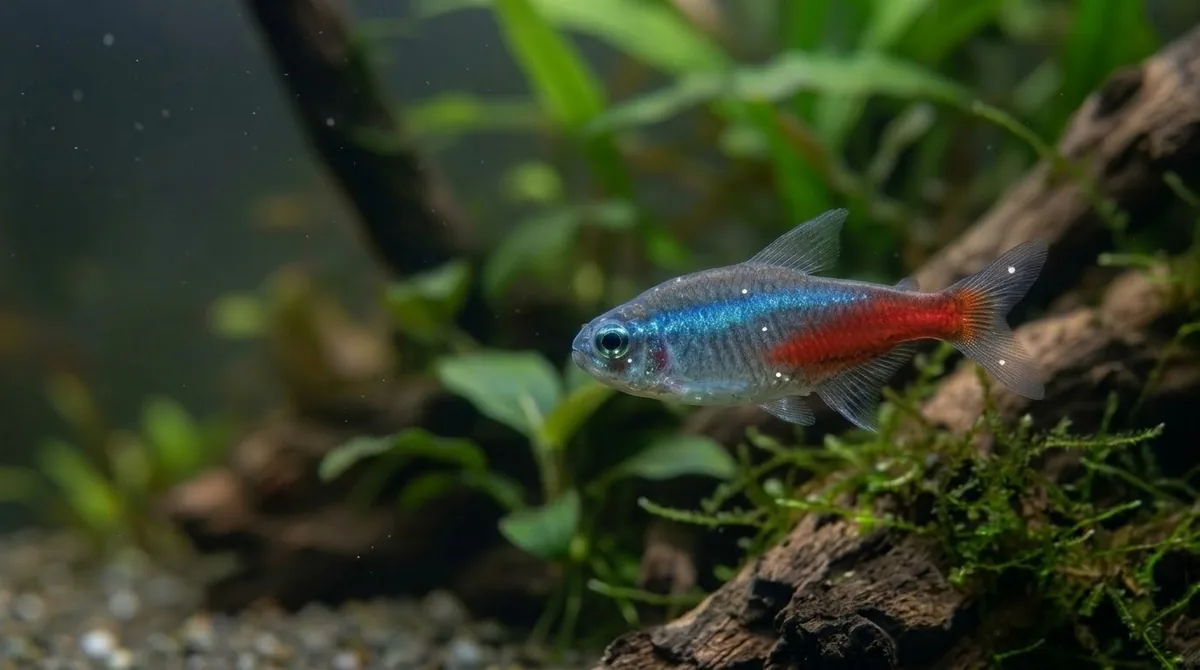
The spots cleared. You did everything right. Then a few weeks later they appeared again. The fish are flashing, the white spots are back, and it feels like the cycle will not end.
This guide explains why ich recurs in tanks where treatment has already worked, what the Livestock Rhythm is actually signalling during an outbreak, and what an aligned response looks like when the goal is not just clearing the parasite but understanding what the tank is saying.
Why treatment alone doesn't work
Ich (Ichthyophthirius multifiliis) is a parasite that most experienced keepers have dealt with. The frustrating part is not the first outbreak — it is the return. Treatment works: heat, salt, and medication all clear the free-swimming stage effectively. But keepers who experience recurring ich are often addressing the same symptom repeatedly without addressing what made the fish vulnerable in the first place.
Ich (Ichthyophthirius multifiliis) needs a live fish to complete its life cycle — it can't simply sit dormant in a tank waiting for a chance. Most recurrences trace back to a source: a new fish, plant, or piece of decor that carried it in, or a few free-swimming parasites that survived an incomplete first treatment. What chronic stress changes is how well a fish's immune system fights off that exposure once it happens — a fish that survived a previous outbreak usually builds real protective immunity, while a chronically stressed one is far more likely to develop a visible infection from an exposure a healthier tank would shrug off. That's the biological reality that explains recurrence: return the tank to the same stressful conditions, and the next exposure is more likely to turn into another outbreak.
The cycle continues not because the treatment was inadequate but because the underlying conditions that allowed the parasite to gain a foothold were never changed. The drift that produced the first outbreak continues to produce subsequent ones.
"Ich doesn't come back because treatment failed. It comes back because the tank it lives in didn't change."
Ich as a Livestock Rhythm signal
In ARA, an ich outbreak is a Livestock Rhythm signal — it is the tank's way of making visible a stress that was already present. The signal is not the ich itself but what the ich reveals: that the fish in this tank have been under enough chronic stress that an exposure a healthier tank would likely have fought off instead turned into a visible infection.
The ARA question after an ich outbreak is not only "how do I clear the spots?" It is: "what compromised my fish's ability to fight this off, and where did the exposure actually come from?" Several stressors commonly predispose tanks to ich outbreaks, each in a distinct way:
Temperature instability — the most common overlooked cause. A heater that cycles, a room that changes temperature seasonally, or a tank placed near a window can create daily temperature swings that chronically stress fish without producing a test-kit-readable problem. The misalignment is invisible until the Livestock Rhythm reveals it.
Overcrowding — too many fish produces ongoing aggression, competition for food, and elevated background ammonia from bioload. All of these are chronic stressors that suppress immunity over weeks. The keeper rhythm may have been consistent, but the tank's carrying capacity has been exceeded.
New fish introduction without quarantine — introducing new fish without a quarantine period is the most direct route for ich introduction. But even quarantined fish introduced to a stressed tank can trigger an outbreak in fish that were already compromised. The introduction becomes the visible trigger; the existing suppression is the underlying cause.
Post-water-change shock — large, infrequent water changes with significantly different temperature or chemistry can trigger ich outbreaks in the days following. The change itself stresses the fish, making them more vulnerable to any ich lingering from an incomplete earlier treatment, or freshly introduced around the same time.
Elevated nitrate over time — not the emergency of ammonia or nitrite, but nitrate that's been creeping up for weeks is a sign of accumulating chronic stress even before it reaches any single "danger" number, and the concentration that actually matters varies by species and by how the reading is measured. A tank where water changes have slipped is a tank where fish are chronically stressed in a way that standard test results may obscure until the Livestock Rhythm signals it.
Fish behaviour, colour, appetite, and social dynamics reflect the state of the whole system. A fish that was healthy before an ich outbreak and healthy after clearing it isn't giving you useful information. The fish that were suppressed enough to show spots are telling you something the water tests aren't.
Finding what the tank is actually saying
The first step after clearing an ich outbreak is observation, not immediate change. List what you know: when did the outbreak appear? What changed in the two to four weeks before it? New fish? New food? Seasonal temperature change? Room temperature shift? A large water change? A filter cleaning?
Once the most likely recent change is identified, that is the pressure to address. If nothing changed externally, the next question is what has been accumulating: has the cleaning routine slipped? Is the tank overcrowded relative to what it was six months ago — fish grow? Is the heater still working accurately, not just "the light is on" but measured with a separate thermometer?
Get a second thermometer and log tank temperature at the same time each day for one week. Temperature instability shows up in this log far more often than keepers expect — a swing of two or three degrees across a day can be enough to suppress immune function chronically without ever looking like an obvious problem. The keeper rhythm felt consistent; the thermal environment had been drifting.
Also test nitrate, not just ammonia and nitrite. Rising or persistently elevated nitrate in a community tank with recurring ich is often part of the picture, even though no single cutoff applies safely across every species and test method. It will not appear as an emergency on a test kit, but it is the kind of background misalignment that the Livestock Rhythm will eventually surface.
"The ich is not the problem. The ich is the reading. The problem is what suppressed the fish enough to let it appear."
Clearing the spots is the easy part — ich responds reliably to heat, salt, or medication. The harder question, each time it comes back, is what in the tank keeps letting it happen. Skip that question and treatment just resets the clock until the next outbreak.
Aligned response to recurring disease
An aligned response to recurring ich is different from a treatment response. Treatment asks: "How do I clear the spots?" An aligned response asks: "What does this tank need to stop producing outbreaks?"
The practical sequence works in four steps. First, address the current outbreak: raise temperature to 30°C over 48 hours and hold for 10 days (the heat method), add salt at 1–2 tbsp per 10 gallons, or use medication if fish are sensitive to heat. Second, during the clearing period, identify the underlying pressure using the approach from Module 3 — do not wait until the spots are gone to begin this observation. Third, after the tank has cleared, address that pressure: stabilise temperature, reduce stocking density, restore the water change rhythm, or establish a quarantine process for new arrivals. Fourth, watch for six to eight weeks.
If no recurrence appears within that window, the underlying pressure was identified and addressed. If it returns, something was missed or there is a second stressor layered beneath the first. Do not return to the same keeper rhythm that produced the outbreak and expect a different result. The Livestock Rhythm will keep signalling until the signal is read.
The aligned response also means accepting that some tanks require structural change — not just a return to previous routines. A tank that has been producing ich outbreaks every few months may need a genuine reduction in stocking density, a new heater, or a change to the water change frequency. These are not admissions of past drift so much as they are the practical steps of an ecological forgiveness: releasing the conditions that produced the pattern and building the ones that will not.
When ich comes back after you thought it was gone, the impulse to treat harder is completely understandable — I've felt it too. But the anxiety we carry after a recurring outbreak tends to push toward more intervention, which adds variables the tank is already struggling to absorb. That frustrated energy is actually useful information: it's telling you that something in the system needs a different kind of change, not a more aggressive version of what already happened. Sit with the observation before the response.
A tank with a history of recurring ich can absolutely become a stable one — fish immune systems bounce back once the chronic stress behind them is actually removed. What changes the odds isn't luck; it's whether the underlying stressor gets fixed, rather than just the visible outbreak. Each past episode is really just a record of what the tank needed and didn't get yet.
Not all phase transitions represent failure. A keeper may deliberately reset a system — to treat a persistent illness, reconfigure a setup, or start a new cycle after a crash. That's different from a crash-driven regression: a reset is a keeper decision, not a system breakdown. The tank moves through its early stage again, subject to the same developmental arc — but the keeper's accumulated knowledge shapes how the new cycle is managed.
- Hines, R. S., & Spira, D. T. (1998). Ichthyophthirius multifiliis: A model of cutaneous infection and immunity in fishes. Immunological Reviews, 166, 163–178.
- Nielsen, M. E., Buchmann, K., & Jørgensen, R. J. (2013). Immunity to Ichthyophthirius infections in fish: A synopsis. Developmental and Comparative Immunology, 41(2), 243–252.
- Nowak, B. F., & LaPatra, S. E. (2015). Epizootiology of Ichthyophthirius multifiliis infections in fish: A review. Journal of Fish Diseases, 38(2), 97–109.
- Wang, X., Sun, G., Feng, S., et al. (2021). Conjoint applications of meta-analysis and bioinformatic data toward understanding the effect of nitrate on fish. Aquaculture, 545, 737221.
- Xing, Y., Wang, J., Wang, L., et al. (2021). Effects of chronic nitrate exposure on the intestinal morphology, immune status, barrier function, and microbiota of juvenile turbot (Scophthalmus maximus). Ecotoxicology and Environmental Safety, 208, 111571.