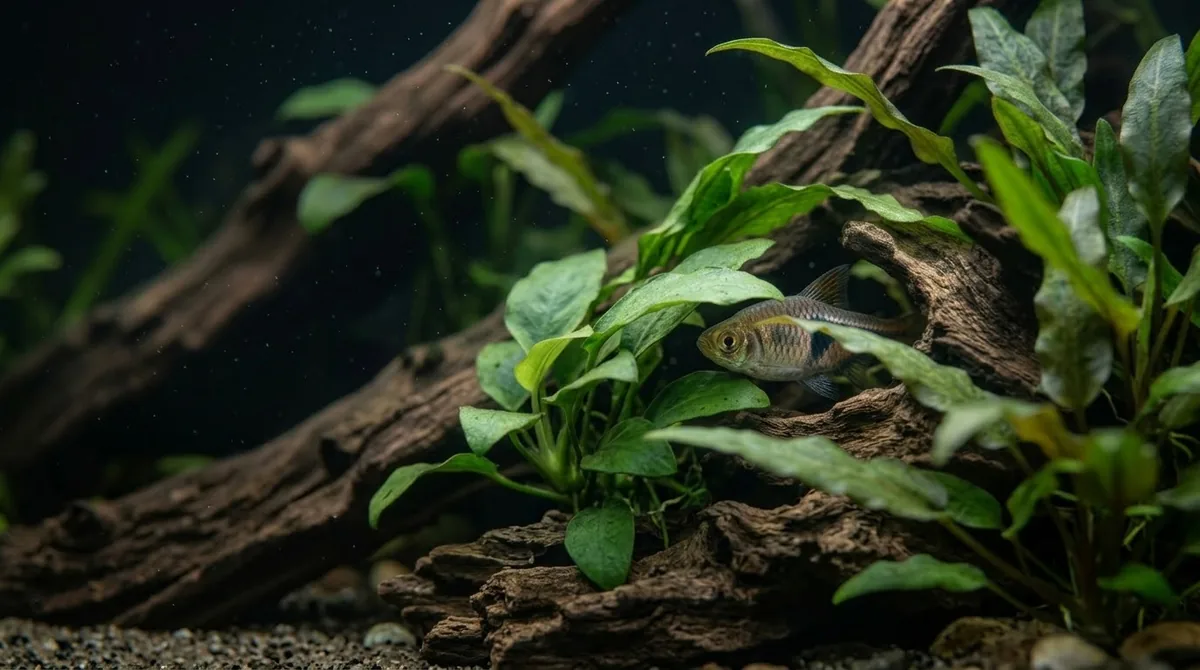
My Fish Are Hiding —
What Does It Mean?
Fish behaviour is the most honest signal a tank can send. This is how to read it.
You walk past the tank and the fish are gone. Or they are tucked into a corner, barely moving. They were fine yesterday. Now something has changed — and you are not sure if it is serious.
Fish hiding is alarming because it feels invisible. Nothing looks broken. But ARA treats fish behaviour as one of five ecological rhythms — and most hiding behaviour is information before it is a problem. This guide explains how to read it.
Fish going quiet is
one of the most informative things you can watch.
It is also one of the most worrying. When fish stop being visible — when they retreat behind plants, under driftwood, into corners — most keepers feel an immediate need to do something. The absence itself is alarming.
But before acting, it is worth separating two very different situations. The first is natural hiding: many species are inherently shy, nocturnal, or refuge-dwelling. Catfish, loaches, kuhlis, and many plecos spend most of their time hidden. This is not stress. It is their nature. If the hiding behaviour is consistent with how the fish have always behaved, it is probably not a signal at all.
The second is changed behaviour: fish that were previously active and visible are now withdrawn, or hiding in ways they did not before. This is the situation that deserves attention — because fish behaviour is a direct readout of how the system is being experienced from the inside.
Is this new behaviour, or has it always been this way? If it is new, what changed? Something in the tank, or something in your care pattern? The answer to those two questions will guide everything else.
Fish behaviour is
a rhythm.
ARA names five ecological rhythms that run simultaneously in every aquarium: Water, Biological, Environmental, Livestock, and Keeper. Fish behaviour is the Livestock Rhythm — and it is often the most sensitive indicator in the system, registering changes that water tests cannot yet show.
When fish go quiet and withdrawn, they are usually responding to one of several things. Not all of them are crises.
Animals often show what numbers cannot. A fish hiding in a corner before ammonia shows on a test kit is not being dramatic. It is reading its environment at a resolution that your instruments do not have. The Livestock Rhythm speaks first.
New environment. Fish introduced to a new tank, or a tank that has been significantly rearranged, will often hide for days or even weeks. This is normal and expected. The system is unfamiliar. Give it two weeks before drawing conclusions.
Water quality drift. Elevated ammonia or nitrite, declining oxygen, or a significant pH shift can all cause withdrawal. Fish are often stressed by deteriorating water before parameters reach visibly alarming levels. A parameter check is worth doing when behaviour changes — not because you expect to find a crisis, but to rule one out.
Temperature change. A heater failure, a cold room, or a tank moved near a window can shift temperature enough to slow metabolism and encourage hiding. Check the thermometer.
Aggression from tankmates. This is often invisible to the keeper. A dominant fish may be chasing others back into hiding when you are not watching. Look for fin damage, missing scales, or fish that only emerge to eat and then immediately retreat.
Illness. A fish that is unwell will often retreat. Look for visible symptoms — clamped fins, irregular swimming, spots, loss of colour — alongside the hiding behaviour.
Observation before
intervention.
The most common response to hiding fish is to add something — a medication, a stress coat, a water conditioner. This impulse is caring. But in most cases, what the fish needs is not a treatment. It needs the stressor identified and reduced. Adding chemistry to an already stressed system can compound the problem.
ARA calls this the principle of observation before correction. Before you add anything, spend one or two days watching carefully. Note exactly where the fish are hiding, when they emerge, whether they are eating, and whether their appearance has changed. This observation is not passive — it is diagnostic.
Not every visible change is a signal to intervene. Some are transitional, some are adaptive, and some need to be watched before they can be read honestly. Fish hiding behaviour is almost always one of these — it becomes clearer with observation, not with action.
A hiding fish tells you where it ended up, not why it got there. Before changing anything, ask what pushed it into that corner in the first place — a water shift, a new tankmate, a light that's too bright. Address that, and the hiding usually stops on its own. Treat the hiding directly and you're working from the wrong end of the problem.
During your observation period, do one parameter check — ammonia, nitrite, and nitrate at minimum. This is not to diagnose the fish; it is to understand the background conditions they are living in. If parameters are safe and the behaviour is new, look at what changed in the last week: a new tankmate, a moved decoration, a missed water change, a heater that runs hotter in warm weather.
If you see visible illness symptoms alongside the hiding, that changes the calculus. Identify the illness specifically before treating. A broad-spectrum medication applied to the wrong condition does more harm than the condition itself in many cases.
Two days of watching.
Then one aligned action.
Spend one or two days watching before doing anything beyond a parameter check. Make note of: when do the fish come out, if at all? Do they eat? Do they appear physically normal? Is there any interaction between fish that might indicate aggression?
If the fish are new to the tank, the aligned response is to wait. Add hiding places if there are not enough. Keep lighting moderate. Do not rearrange the tank. Give the fish time to map the space.
If the fish were previously settled and behaviour has changed, look for the single most likely stressor. Water quality is the most common culprit — a modest water change of 20–25% is almost always safe and reduces any accumulated load. If aggression is suspected, remove the aggressor temporarily to observe whether the others emerge.
When fish go quiet, the keeper's job is to read what's drifted before reaching for a fix — then make one small, aligned adjustment in that direction. Most hiding resolves when the stressor is removed, not when something new gets added.
If hiding persists beyond two weeks with no identified cause and no change, that is the moment to consult more carefully — whether that is a knowledgeable local fishkeeper, a vet with aquatic experience, or an AI companion that can help you think through the pattern without rushing to a single answer.
Walking past a tank and finding the fish gone — tucked away, motionless, invisible — can trigger an immediate alarm that makes it hard to observe calmly. That alarm is worth noticing in itself. The urge to tap the glass, rearrange hiding spots, or dose something is a natural response to feeling helpless. But fish that are hiding are already signalling — the tap or intervention adds a variable to a system that is already under stress. The most useful keeper action in the first hours of unexpected hiding is stillness: sit near the tank, watch without interacting, and give the fish time to show you what's actually going on.
Fish do not hide to communicate distress. They hide because their environment is asking them to. When you change the environment — when you remove the stressor rather than masking it — the fish follow. That is how the Livestock Rhythm works: it reflects conditions, not personality.