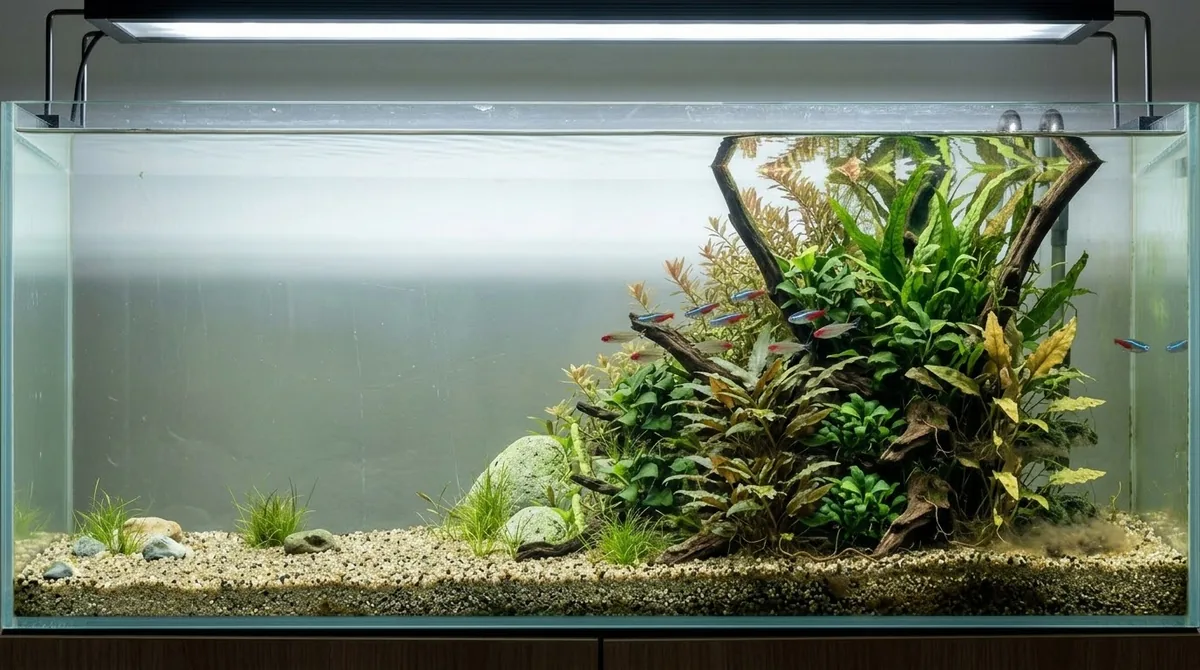
An Established Tank
Is Not a Finished Tank.
Why long-running tanks still struggle — and what they are usually telling you.
The cycle is behind you. The bacteria are established, the parameters have settled, and the tank has been running for months. This is where most guides stop.
But this is also where a quieter, slower kind of difficulty tends to begin. The fish seem slightly off. Something keeps coming back. The parameters look fine, and yet something is not quite right.
An established tank is a different system from a cycling one. It asks something different from its keeper: less about building, more about reading. This is about learning to do that.
The cycle was
never the finish line.
A tank that has been running for six months is a fundamentally different system from one that just completed its cycle. The bacteria are established, the chemistry has found a rhythm, and the fish have settled. The urgent, unstable phase is over.
But established tanks have their own kind of difficulty — slower, quieter, and easier to miss. Problems do not spike suddenly. They drift. Small pressures compound over weeks until something finally becomes visible, and by then it has usually been building for a while.
Stability is not something you arrive at. It is something you maintain — quietly, consistently, even when nothing visible is going wrong.
An established tank has capacity — the ability to absorb a missed water change, an extra feeding, a small disruption — and return to balance on its own. But that capacity is not unlimited. The keepers who maintain healthy tanks over years are not the ones who never make mistakes. They are the ones who read the system well enough to catch the slow drifts before they become problems.
An established tank has entered a stage where the ecosystem sustains itself rather than builds. The challenge at this stage isn't skill. It's attention. Most problems in established tanks aren't failures of the keeper. They're slow drifts — small misalignments that any keeper can learn to catch once they know what to look for.
Not all phase transitions represent failure. A keeper may deliberately reset a system: to treat a persistent illness, reconfigure a setup, or start a new cycle after a crash. That's different from a crash-driven regression: a reset is a keeper decision, not a system breakdown. The tank moves through its early stage again, subject to the same developmental arc. But the keeper's accumulated knowledge shapes how the new cycle is managed.
Cycling and maintaining are different phases, and they ask for different things. During cycling, the system is building. During maintenance, it is sustaining. What helps during one can be unnecessary or counterproductive during the other. Learning to feel which phase you are in, and what it actually needs, changes how the hobby feels.
Five things the tank
is always doing.
Aquatic Rhythm Alignment organises an aquarium into five ecological rhythms: five layers of the system that are always active, always shifting, and always speaking. Problems in established tanks almost always trace back to drift in one or more of these rhythms.
Reading them together gives you a fuller picture than any single test can.
Most established-tank problems are not sudden events. They are the accumulation of small misalignments across one or more of these rhythms. Reading the system well means knowing which rhythm is drifting — before it becomes a visible problem. The next modules examine the most common drift points.
Most problems have
one root.
When a tank is struggling — fish getting sick, algae returning, parameters that drift — it can feel like everything is wrong at once. It rarely is. There is almost always one thing that is the primary pressure, and everything else is responding to that.
Treating everything at once is exhausting and usually does not work. But finding the one thing that is actually driving the others — and addressing just that — often changes everything.
The four most common culprits: nitrate that has been quietly building up, a fish load that is higher than the system can comfortably handle, water chemistry that does not suit the specific fish in the tank, and a maintenance routine that has become too irregular for the system to fully recover between sessions.
None of these are dramatic failures. They are all slow drifts — small movements away from balance that compound quietly until they become visible. The difficult part is that by the time you notice them, they have usually been building for a while.
In most cases, one pressure is placing more strain on the system than everything else combined. Find it and remove it, and the other issues often begin to resolve on their own. The skill is learning to look for that root pressure, rather than treating each symptom separately. That shift — from reactive to ecological — is one of the things that changes how a keeper experiences the hobby.
One specific pattern worth naming in established tanks: the gradual accumulation of small additions that individually seem fine but cumulatively exceed the system's stable carrying capacity. One more fish, one more feeding, one more decoration reducing flow — none feels significant. But over months, the system that was handling its load comfortably is now at the edge of it, and the margin for error that forgave small inconsistencies has quietly disappeared. This kind of drift rarely announces itself. It shows up as a tank that used to be stable and now isn't, without any obvious single cause.
The filter is not
a machine. It is a habitat.
Most people think of the filter as a mechanical device — it moves water, it catches debris, it can be cleaned when it looks dirty. That understanding is incomplete, and it leads to one of the most common mistakes in established tank care.
The filter media is where the majority of your bacterial colony lives: the sponge, the ceramic rings, the bio-balls. Not in the water. Not on the gravel. On those surfaces. Those billions of bacteria are what make your tank stable. They are the cycle, running continuously, every hour of every day.
This means that how you clean your filter matters enormously. Rinsing media under tap water — even briefly — exposes the colony to chlorine, which kills bacteria rapidly. Replacing all the media at once removes the entire colony in a single action. The tank will effectively need to re-cycle, slowly, while the new media builds up. You will not always notice immediately. But over the following weeks, parameters will drift, fish will seem slightly off, and the cause will be invisible.
What works is straightforward once you understand why it matters. Clean filter media in old tank water removed during a water change — tap water kills the colony. Replace no more than a third of the media at a time, and wait at least four weeks before replacing any more. This preserves the colony while still maintaining the mechanical function of the filter.
A small ammonia or nitrite reading in an established tank, even 0.25 ppm, is a signal. So is a tank that suddenly seems less stable, or fish that recover more slowly from minor stress than they used to. These are not always caused by filter disruption, but if you recently cleaned or replaced media, that is where to look first.
The filter is the most important piece of equipment in the tank — not because of what it does mechanically, but because of what lives inside it. Treating it gently, and replacing it gradually, is one of the simplest and most overlooked ways to keep an established tank stable over years rather than months.
Nitrate.
It builds without drama.
After the cycle, ammonia and nitrite are handled. That part is working. But nitrate, the end product of the whole process, has nowhere to go. It does not get broken down further. It simply builds, quietly, every day, until something removes it.
At low levels, nothing looks wrong. Parameters seem fine. Fish look normal. But nitrate is not inert. As it rises over weeks and months, it enters fish tissue through the gills and interferes with how blood carries oxygen. At high concentrations this process is called methaemoglobinaemia, though even at moderate levels the effect is subtler and chronic. Immune function is gradually suppressed. Stress hormones remain slightly elevated. The fish survives, but it is running at a deficit. It is more prone to disease, slower to recover from minor stress, never quite as vivid or active as it could be in cleaner water.
The most common recommendation is to keep nitrate below 20 ppm for sensitive fish, and below 40 ppm for more tolerant species. But the number matters less than the trend. A tank at 30 ppm that is stable is healthier than one at 25 ppm that is rising.
Regular partial water changes — 15 to 25 percent, weekly — are the most reliable way to keep nitrate in check. Live plants help significantly. Overfeeding is one of the fastest ways to accelerate accumulation.
If you suspect nitrate has been higher than it should be for a while, bring it down gradually over a few weeks through regular small water changes, not one large one. That will often produce a visible difference. Fish that have been slightly muted, slightly cautious, suddenly look more alive. They were not sick. They were just finally comfortable.
Your fish are
always telling you something.
A test kit tells you what the water contains at the moment you test it. Your fish tell you what the water has been doing to them — all day, every day, in real time.
Most keepers learn to read numbers before they learn to read fish. That makes sense — numbers feel certain, and behaviour can seem vague. But fish respond to changes in their environment long before a test kit shows anything. By the time a reading is off, the fish have usually been living with it for a while.
This is not about diagnosing disease. It is about knowing your fish well enough that small changes register — a fish that is slightly less enthusiastic at feeding time, one that has moved to a corner it does not usually occupy, a group that has quietly rearranged itself. These are not dramatic signals. But they are real ones, and they come earlier than anything a test will show.
You do not need to know what the change means the moment you notice it. Noticing is enough to start with. It is the beginning of a different relationship with the tank — one based on reading rather than reacting.
You do not need to know what is wrong to know that something has changed. And knowing something has changed — early — is most of what good tank-keeping actually is.
A tank held at consistent, unremarkable parameters, not the ideal reading but a stable one, outperforms a tank chased toward perfect numbers. The chase itself requires constant intervention to stay there. The goal for an established system isn't optimisation. It's a coherent, sustainable routine. Small imperfections that are stable are usually far less damaging than perfect numbers that fluctuate. The keeper who has learned this often does noticeably less, and has a noticeably healthier tank for it.
This kind of attention is a quality that develops over time, through presence rather than study. It is not something you can read your way into. But it grows naturally when you spend time at the tank not looking for problems — just looking. Watching how the fish move through the water. Noticing small shifts that you would never have caught before. The difference between checking and seeing.
Keepers who develop this attention do not spend more time on their tanks. They spend less. They catch things earlier, respond more calmly, and have earned enough trust in the system to leave it alone when it is doing well. That trust comes from knowing the tank well enough to read it. And it makes the hobby feel very different.
In ARA, the fifth ecological rhythm, Keeper Rhythm, is what shapes all the others. A keeper who observes consistently, changes water with coherent continuity, and has calibrated their schedule honestly to their actual capacity creates stability that no product can replicate. The tank reflects the keeper. And an attuned keeper, over time, needs less intervention — not more.
If you've reached a place with your tank where you're spending less time but things are going better, you've built something. Not every keeper reaches that point at the same pace, and the path there often runs through several rounds of "I checked everything and still don't know what changed." That frustration is part of the process, not evidence that you're doing it wrong. That quality of attention grows from those moments of not-knowing as much as from the ones where everything is clear.
Next best action: Create a 72-hour log: record 3 things each day (fish behaviour, temperature, and nitrate readings). After 3 days, review whether the stress pattern is coming from parameters, feeding, or flow.
Review behaviour signals → ← Back to Reading