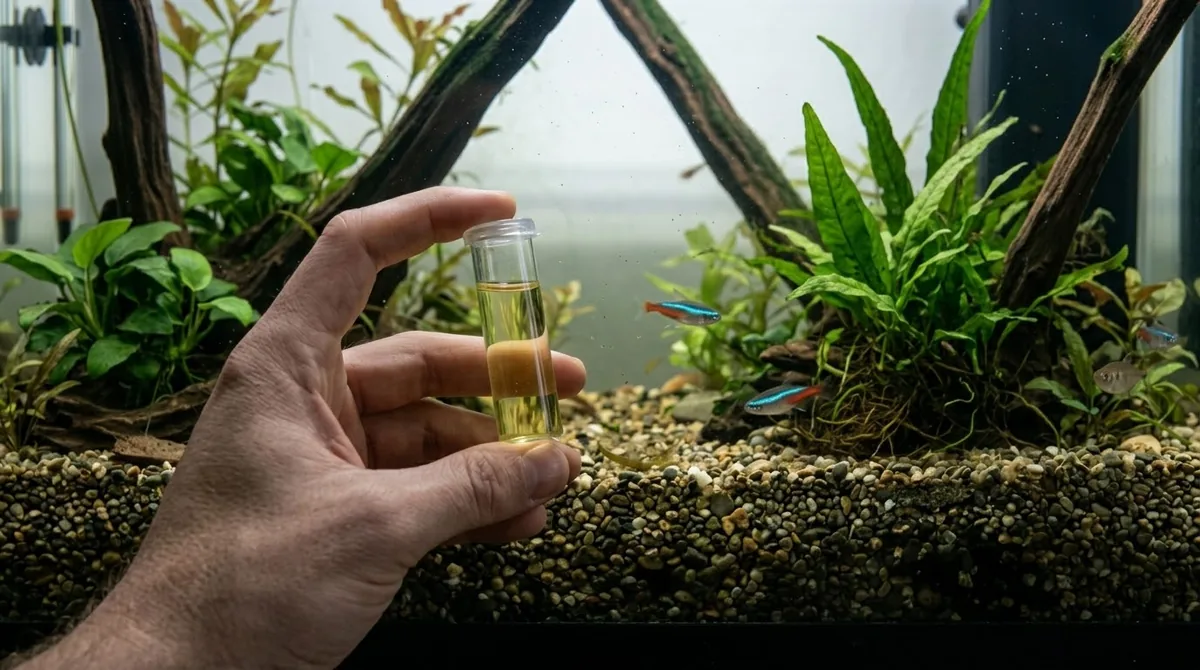
My Fish Are Dying —
But My Water Parameters Look Fine
A test kit measures one layer of the system. Your fish are reading all of them.
Ammonia at zero. Nitrite at zero. Nitrate at a manageable level. The numbers look right — and yet something is clearly wrong. Fish are fading, hiding, not eating, or dying with no obvious cause.
This guide covers what a test kit actually measures, what it misses entirely, how to read the signals your fish are already giving you, and how to find the one thing that is most likely driving what you are seeing.
Your test kit is right.
And it is also incomplete.
A water test that shows ammonia at zero, nitrite at zero, and nitrate at a manageable level is a good sign. It means the biological cycle is running. But it is measuring one specific layer of the system — the nitrogen cycle layer. It says nothing about several other things that fish experience constantly.
Understanding what a standard test kit does not measure is not about finding more things to worry about. It is about knowing where to look when the numbers say one thing and your fish say another.
Temperature stability. A heater that swings 2–3°C through a day is not providing a stable environment. Fish in a fluctuating thermal environment experience chronic stress — even if the average temperature is "correct." The test kit sees nothing of this.
Dissolved organic load. Uneaten food, decaying plant matter, dead invertebrates — these produce compounds that don't show on ammonia tests until they're already degraded. A tank can read clean on a test kit while carrying a significant invisible organic burden.
Dissolved oxygen. Especially in warm water or densely stocked tanks, oxygen depletion is real and rapid. It doesn't appear on a standard test, but fish feel it immediately.
Heavy metals and chloramines. Some municipal water supplies contain chloramines, not chlorine, which standard dechlorinators don't fully neutralise. Copper can leach from new plumbing or decorations. Neither shows on a typical hobbyist test kit.
Social and behavioral stress. A fish being consistently harassed by a tankmate will decline even in chemically perfect water. This never appears on a test.
pH and KH stability across time. A single pH reading can look fine even if pH crashes at night, common in planted tanks without CO2 buffering, or drifts significantly between water changes. A snapshot reading and a stable reading are different things.
Parameters measure the water at the moment you test it. Your fish are measuring the water all day, every day. Those are different things.
A reading can be technically accurate but misleading about the system's actual state. Clean ammonia isn't proof that the tank is well — it's proof that the nitrogen cycle is running. A fish declining in apparently clean water isn't a mystery. It's a test result that's accurate at the test-kit layer while the real pressure operates somewhere the test doesn't reach. The practice is asking what the reading doesn't include, not just what it shows.
Fish behaviour is earlier
than any test kit.
In Aquatic Rhythm Alignment, fish behavior is called the Livestock Rhythm, the ongoing pattern of how fish move, feed, position themselves, and interact. This rhythm is the most sensitive instrument in the tank. Fish respond to changes in their environment continuously, in real time, at a resolution no instrument can match.
Learning to read the Livestock Rhythm means knowing each fish's baseline well enough that a departure from it is visible before it becomes a crisis. These departures often appear days or weeks before any water parameter shifts.
Reduced feeding enthusiasm. Often the first sign. A fish that usually meets you at the glass and now hangs back is communicating something. This happens before any parameter shift — it is the earliest signal the system gives you.
Surface breathing or increased gill movement. These suggest low dissolved oxygen, or gill irritation from dissolved organics or water quality stress. Worth taking seriously even when tests look clean.
Unusual position in the water column. A fish that normally occupies midwater and is now consistently near the bottom, or near the top, is responding to something. Temperature gradient, oxygen availability, or stress can all cause this shift.
Loss of color intensity. Chronic stress suppresses pigmentation. A fish that has faded slightly over weeks is showing a slow drift, not an acute crisis. The gradual nature of it makes it easy to miss — which is why knowing the baseline matters.
Isolation from group. A schooling fish separating from its group is showing stress. This is never just personality. The school offers safety; a fish leaving it voluntarily is a fish that cannot maintain the energy to stay in formation.
Rapid, jerky movement or flashing, such as rubbing against surfaces, indicates skin or gill irritation. This can come from dissolved organics, pH fluctuation, or early parasite presence. The behavior itself is the signal; the cause requires further observation.
Fish behaviour is an ongoing signal that reflects the state of the whole system. The skill is knowing each fish's baseline, so that departures from it are visible. A fish that has always been slightly shy is different from a fish that has recently become shy. The change is the signal.
Almost every struggling tank
has one root.
When fish are declining despite clean parameters, it helps to look for the single pressure that is placing the most strain on the system at any given time. Everything else in the tank is responding to that one thing. Identify it and the rest becomes clearer.
This is not always easy to see. That pressure is often invisible to a test kit, operates slowly, and is easy to normalise once it's been present for a while. But it is almost always findable.
Temperature instability. Check the heater by measuring temperature 3–4 times across a day — morning, midday, evening, night. Many heaters swing more than their specification suggests. A swing of 3°C is significant for fish. If instability is present, the aligned response is a quality heater with a guard to prevent fish from resting against it.
Organic accumulation. Look at what is decaying in the tank. Uneaten food at the back of the substrate, a patch of dying plant, a dead snail buried in gravel. These produce ammonia locally before the test kit catches it, and they also produce compounds the test kit never measures. More thorough substrate vacuuming during water changes, and reduced feeding, address this directly.
Aggression and harassment. One fish chasing another, even if neither looks injured, causes chronic stress in the pursued fish. This is especially common with semi-aggressive species as they mature. The harassed fish stops eating properly, stops resting properly, and maintains a constantly elevated stress response. The only way to see this is to observe behavior for 10 or more minutes without disturbing the tank.
Overstocking, even subtly. A tank slightly above its comfortable bioload doesn't necessarily spike ammonia — the filter handles it. But fish at the edge of their social space, with oxygen slightly below ideal and waste compounds slightly above ideal, experience cumulative pressure that accumulates silently over time. An honest assessment of fish count and size relative to tank volume and filtration capacity is worth making.
Water source drift. Municipal water chemistry can change seasonally. If fish started declining around the same time as a water change, consider whether your water source shifted — a different treatment blend, a seasonal hardness change, or a temporary elevated chloramine level can all be the driver.
The question is not "what test am I missing?" It is "what is the one thing that, if it changed, would change everything else?"
Fading colour, hiding, a general decline — a fish under sustained pressure rarely shows just one sign of it. Rather than chasing each symptom on its own, look for what could be producing all of them at once. The individual readings tend to clear up together once that source is found.
Slow down.
Look at everything once.
The impulse when fish are struggling is to act — add something, change something, do something. But the most useful thing right now is a single, calm, systematic read of the whole system. Not a panic checklist. Not multiple interventions at once. One honest look.
1. Temperature log. Measure at the same time for 3 consecutive days — morning is ideal. Note the range. If it varies more than 1.5°C across the day or between readings, investigate the heater.
2. Behavior observation. Spend 10 minutes at the tank not looking for problems — just watching. Note who is where, who is eating, who is interacting with whom. Compare to what was normal two weeks ago. The change is the signal.
3. Physical scan. Look at every corner of the substrate for decomposing material. Check the filter intake for blockage or restriction. Note any dead or heavily decaying plant matter that may be adding to the organic load.
4. Stocking review. List every fish by species and approximate size. Consider whether the total bioload sits within the filter's comfortable range — not just its stated maximum. A filter running at capacity is not the same as a filter running comfortably.
5. Recent changes. Think back 2–4 weeks. What changed? New fish, new decoration, new water conditioner, new food, a tank rearrangement, a heater adjustment. The underlying cause often arrived around the same time as a change you may have already forgotten.
The cause is almost always findable with this kind of systematic observation. You do not need more tests. You need more looking.
If fish behavior is part of what you are reading, the guide on fish hiding covers the Livestock Rhythm in more detail. For a broader look at tanks where the cycle has completed but problems persist, the cycled tank problems guide picks up from here.
There is a particular helplessness in testing perfect parameters while a fish fades. The test kit was supposed to be the diagnostic tool: it says everything is fine, and yet something is clearly not. That gap between what the numbers say and what the tank is expressing can lead keepers to distrust their own observation, to repeat the tests in case they made an error, or to reach for a treatment when there is no identified disease. The test kit reads chemistry. The keeper reads the fish. When those two signals conflict, the fish is not wrong. Something the test kit does not measure is operating, and that something is findable through the observation methods in this guide.