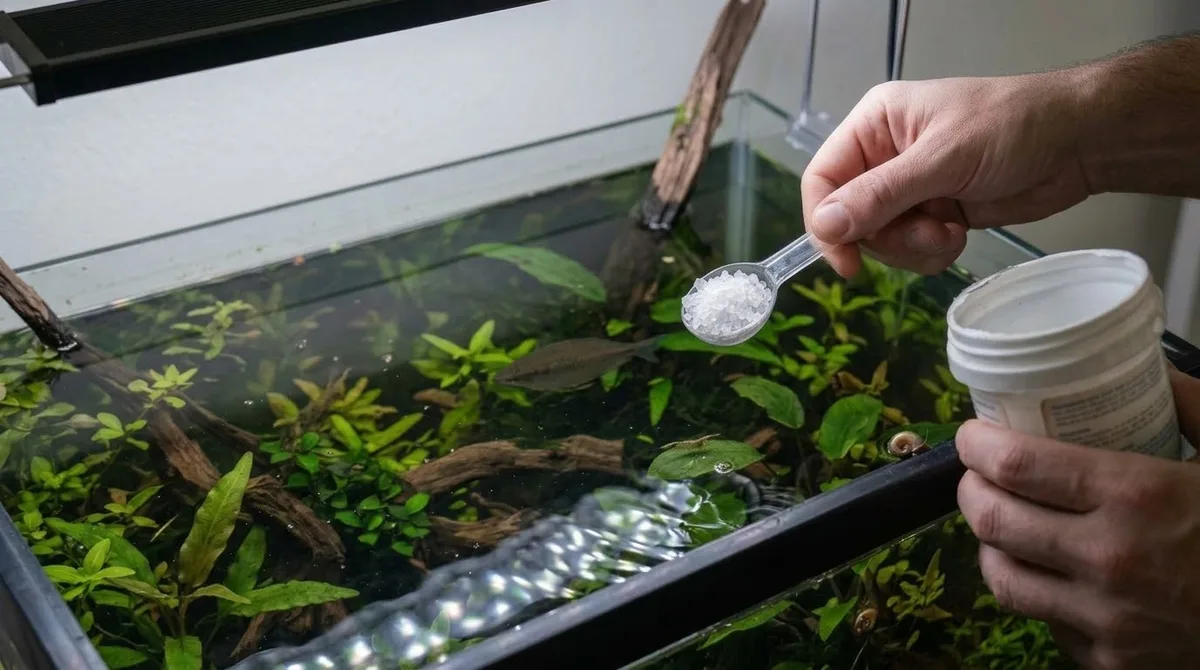
Should You Add
Aquarium Salt?
It solves a couple of real problems, and gets used for a dozen it was never suited to.
A fish looks off, a fin looks ragged, or a new arrival hasn't settled — and the tub of aquarium salt comes out of the cabinet. Reaching for it is one of the oldest reflexes in the hobby, handed down from keeper to keeper long before anyone explains what it actually does once it's in your water.
This guide covers the handful of situations where salt genuinely helps, why it doesn't touch most of what it gets reached for, and what it does to the plants and invertebrates sharing that water once it's in there.
The label says
safe for every tank.
The container usually makes a broad promise: won't harm fish, plants, or filtration, safe to use with every water change. That claim is doing a lot of quiet work. It's usually tested against fish tolerance at a labelled dose — not against what a shrimp colony or a bed of stem plants can handle at that same concentration.
Reaching for it isn't a strange thing to do. You'll find it cheap, shelved next to the test kits as a basic staple, and handed down by keepers who never got the mechanism explained to them either. The habit is older than the explanation.
Here's the short version before the rest of this guide: aquarium salt does a real job in three specific situations, and does nothing for most of what it gets used to treat. For everything else living in that water, it isn't neutral either.
That claim covers fish at a specific dose, tested in a fish-only context. It says nothing about the plants, shrimp, or snails sharing your tank — their tolerances sit considerably lower, and the label was never written with them in mind.
Three real jobs.
Not the dozen it gets asked for.
A fish under stress — from an injury, a rough transport, or a sudden drop in water quality — spends real energy keeping its internal salt balance stable against the surrounding water. A mild, temporary rise in tank salinity narrows that gap, giving a compromised fish less internal work while it recovers. Osmotic support is real. It's also short-term — a bridge, not a standing treatment.
During a cycling spike, dissolved chloride competes with nitrite for the same anion-transport pathway at the gill — the chloride cells that also take up nitrite — so holding a modest salt level can blunt nitrite's toxicity while the second bacterial colony catches up. How much protection that actually buys depends on species, fish size, and the ratio of chloride already in the water to the nitrite spiking it, and it does nothing to the nitrite itself. Keepers still use this technique for one situation — an active nitrite spike, alongside fixing whatever's driving it, not a permanent additive.
Held at a high enough concentration for long enough, salt can also shorten the free-swimming stage of a few external parasites, ich among them. There's no single teaspoon-per-gallon number that applies safely across species here — published treatments differ meaningfully by fish species and size, and a dose sized for one community member can stress or kill a different one sharing the same water. A pinch added at every water change reaches none of the concentration or duration a real treatment needs. It just sits there.
"Salt at a therapeutic dose is medicine, held for a reason and removed on a schedule. Salt at a tonic dose is neither medicine nor harmless. It's just present."
It doesn't leave
on its own.
Water evaporates. Salt doesn't. Every top-off with fresh water restores volume without removing a single dissolved grain, so if you add "a little salt, just in case" at every water change, the level only climbs from there. Unlike most things added to a tank — medication that breaks down, ammonia that converts — dissolved salt has no exit except an actual water change that swaps out the salt-laden water itself.
Plenty of common stem and rosette plants show stress well below the concentration marketed as fish-safe: curling leaves, browning edges, growth that stalls without an obvious cause. The "safe" claim was measured against fish, not against them.
Shrimp and snails sit even lower on that scale. A level a labelled fish-safe dose wouldn't touch can visibly stress a shrimp colony within days — one of the more common, least explained die-offs reported in mixed tanks.
And for the fungal or bacterial issues salt most often gets reached for — ragged fins, cloudy patches, the kind of thing that looks like it needs something right now — it usually does nothing at all. Salt works against a narrow set of parasites and osmotic stress. It was never the tool for those other two.
A community tank with fish, plants, and shrimp sharing the same water rarely has a dose that helps one group without risking another. That's not a sign you didn't research enough — it's a genuine constraint of keeping different tolerances in the same box of water, and it's worth treating as one.
Diagnose first.
Salt is a tool, not a default.
Before reaching for it, name what's actually happening. Visible white spots and flashing point toward a parasite, where a real therapeutic dose might help. A fresh nitrite reading during cycling points toward the nitrite-mitigation use. A fish recovering from an injury or a rough move points toward brief osmotic support. Ragged fins or a cloudy patch usually point somewhere salt can't reach at all. Know that before you add anything.
Check who else lives in your tank before deciding. Plants and invertebrates change the calculation completely, even when every fish in the tank would tolerate the dose without trouble.
If salt genuinely is the right tool for what's in front of you, treat it as a bounded intervention: know the concentration you're aiming for, know how long it needs to hold, and have a water-change plan ready to bring it back out once the job is done — rather than letting it become a permanent ingredient kept "just in case."
"The keepers who use salt well aren't the ones who avoid it. They're the ones who can say what it's there for, and when it's coming back out."
- Lewis, W. M., Jr., & Morris, D. P. (1986). Toxicity of nitrite to fish: A review. Transactions of the American Fisheries Society, 115(2), 183–195.
- Svobodová, Z., Máchová, J., & Poleszczuk, G. (2005). Nitrite poisoning of fish in aquaculture facilities with recirculating water. Acta Veterinaria Brno, 74, 129–137.
- Garcia, L. O., Becker, A. G., Copatti, C. E., Baldisserotto, B., & Radünz Neto, J. (2007). Salt in the food and water as a supportive therapy for Ichthyophthirius multifiliis infestation on silver catfish, Rhamdia quelen, fingerlings. Journal of the World Aquaculture Society, 38(1), 1–11.
- Mifsud, C., Rowland, S. J., & Read, P. (2003). Use of common salt to treat ichthyophthiriasis in Australian warmwater fishes. North American Journal of Aquaculture, 65(2), 124–127.
- Larcombe, E., Alexander, M. E., Snellgrove, D., Henriquez, F. L., & Sloman, K. A. (2025). Current disease treatments for the ornamental pet fish trade and their associated problems. Reviews in Aquaculture, 17(1), e12948.