Clamped Fins
and Fin Rot
Reading disease before it spreads.
A fish holding its fins pressed close to its body instead of relaxed and flared looks unmistakably unwell — but clamped fins alone don't say why. Ordinary stress and an active bacterial infection can look identical for the first day or two.
This guide explains what clamping actually signals, how to tell it apart from fin rot that's genuinely progressing, and why the two call for very different responses.
Fins pulled tight
against the body.
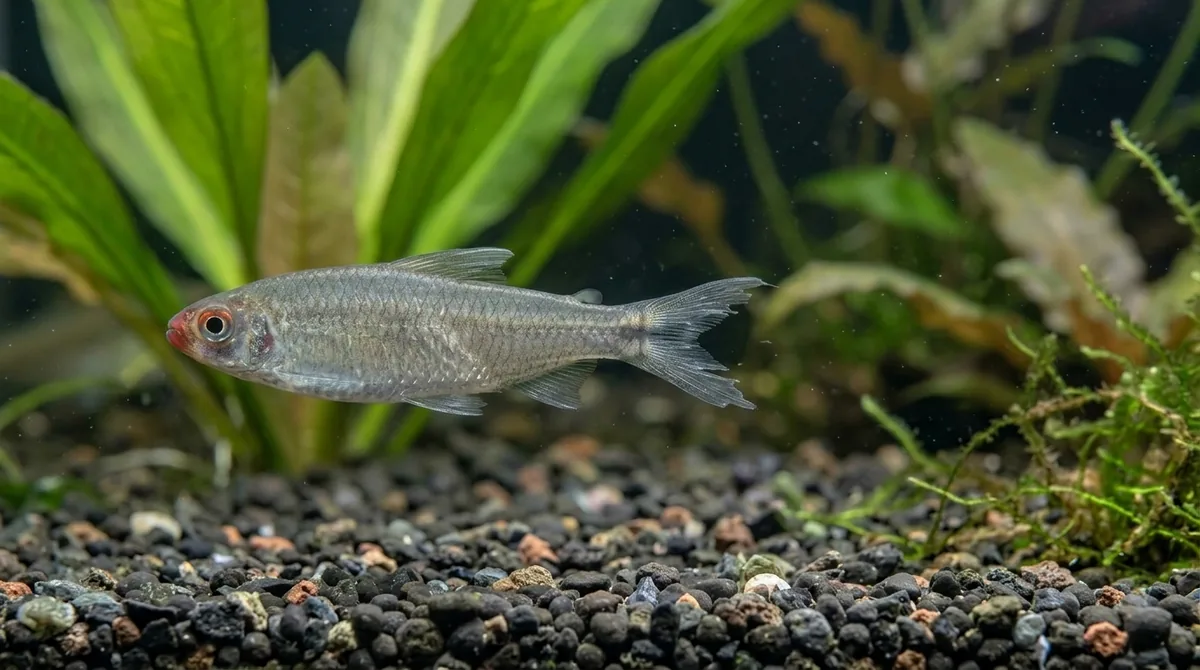
A fish with clamped fins holds them pressed close to its body, folded down and in. A comfortable, healthy fish normally carries them spread out instead. It's one of the most reliable general signs that something is off. It's also one of the least specific — clamping shows up in almost every kind of distress, from a bad water change to a genuine infection.
That non-specificity is exactly why clamped fins on their own aren't enough to act on. Two fish can show the identical posture for completely different reasons. One's tank just had a rough week; the other has a bacterial infection actively eating away at fin tissue. Nothing about the clamping itself distinguishes the two in the first day or so.
What separates them is what happens next: whether the fins themselves start visibly deteriorating, or whether they're just held tight while everything else about them stays intact.
Look at the fin edges specifically, not just the posture. Are they smooth and intact, just folded in close? Or are the edges ragged, frayed, whitish, or visibly shorter than they were a few days ago? That distinction matters more than the clamping itself.
One resolves in days.
The other keeps eating.
Stress-clamping. Poor water quality, a sudden temperature shift, a new arrival unsettling the tank, or aggression from a tankmate can all make a fish clamp its fins. None of that requires any infection. The fins themselves stay physically intact — the shape and edges don't change day to day, even though the fish is clearly uncomfortable. Remove the stressor and the posture usually relaxes within a few days.
Fin rot. This is a genuine bacterial (occasionally fungal) infection that erodes fin tissue from the edges inward. It typically starts as a thin whitish or reddened line along the fin margin, then progresses to visibly ragged, shortening, or disintegrating edges over the following days. Unlike stress-clamping, fin rot has a direction — it gets measurably worse if left unaddressed, not just uncomfortable-looking.
Physical damage. Nipping from a tankmate or an injury from décor tears fin tissue unevenly. The damage is often concentrated on one side or one specific fin, rather than spread evenly across all of them. This can look similar to early fin rot but has a different cause and a different fix.
"Fin rot is rarely the original problem. It's usually an opportunistic infection that moved in once water quality or stress had already worn a fish down. That's why treating the water often matters more than treating the fin."
Compare today
against a day or two ago.
The single most useful thing you can do with clamped fins is compare the fin edges against how they looked a day or two earlier. A quick phone photo from roughly the same angle each day makes this comparison far more reliable than memory. If the edges are unchanged, you're most likely looking at stress. If they're visibly more ragged or shorter, that's genuine progression.
Test ammonia, nitrite, nitrate, and temperature regardless of which one you suspect. Fin rot is opportunistic. It takes hold far more easily in a tank that's already under some kind of chemical or thermal stress — the water itself is almost always part of the picture, even when an infection is genuinely present.
Watch for aggression too. A dominant tankmate chasing and nipping a subordinate fish produces damage that can be mistaken for infection, and no amount of medication fixes a problem that's actually behavioural.
Fin rot's progression is often too slow to notice by eye alone from one day to the next — the change becomes obvious only in hindsight. A same-angle photo taken daily turns a gradual drift you might rationalise away into a comparison you can't argue with.
Fix the water first,
then treat what's left.
If the fins are intact and it looks like stress, the aligned response is to find and remove the stressor. Correct any parameter that's off, restore a stable temperature, or separate an aggressive tankmate. No medication is needed, and the fins typically relax on their own within a few days once the cause is gone.
If fin rot is genuinely progressing, start with the water, not the fin. A significant water change and a close look at ammonia, nitrite, and nitrate resolves a meaningful share of early fin rot cases on its own. It removes the conditions the infection was exploiting in the first place.
If the edges keep visibly deteriorating after a few days of clean, stable water, that's when a targeted antibacterial treatment is warranted. Reaching for medication first, before ruling out water quality, treats a symptom while leaving the actual cause untouched.
"A fish's fins don't fail without a reason behind them. Chasing the fin while ignoring the water treats the part the keeper can see, not the part that's actually driving it."