Why Is My Fish
Flashing or Scratching?
Rubbing against gravel or décor is rarely random.
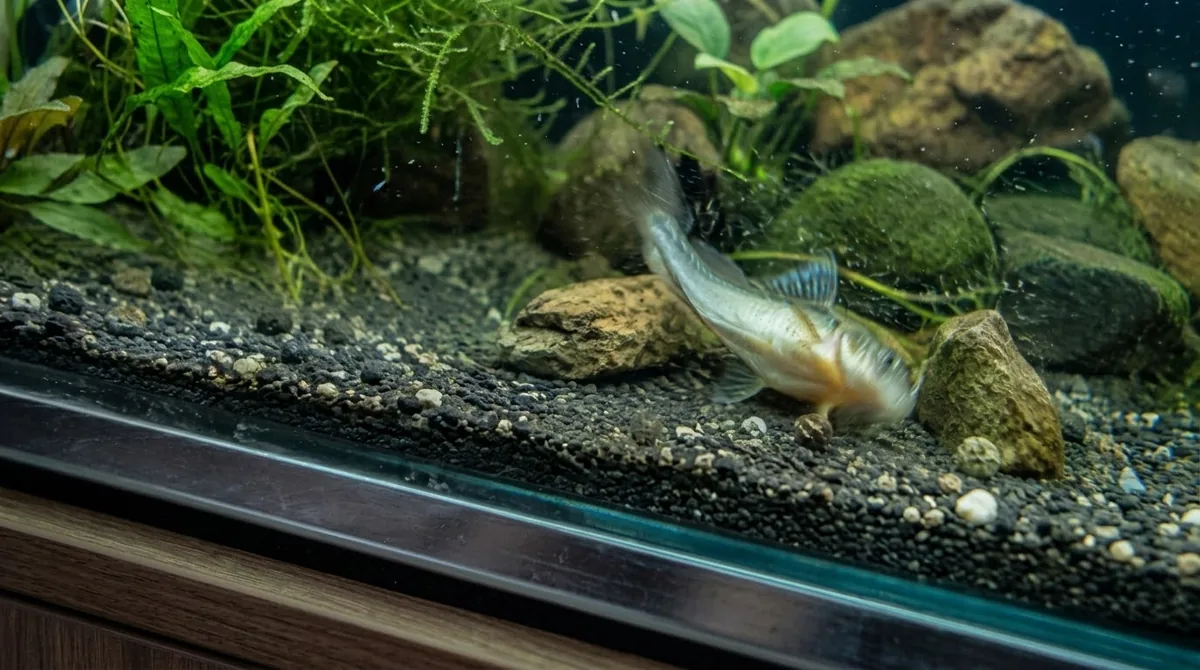
A fish suddenly darts sideways and scrapes its body against the gravel, a rock, or the glass, then swims on as if nothing happened. It looks abrupt, a little alarming, and easy to dismiss if it only happens once.
This guide explains what flashing and scratching actually signal, the three usual causes behind it, and how to tell them apart before reaching for a treatment that might not match what's actually going on.
Flashing looks like
an itch. It rarely is just that.
Flashing is the term keepers use for a fish suddenly twisting sideways and rubbing its body against gravel, rocks, décor, or the glass. It looks abrupt — a fish that was swimming normally scrapes itself against a hard surface, then carries on as if nothing happened.
A single flash, once in a while, is close to meaningless. Fish do occasionally rub against something for no obvious reason, much like a person scratching an itch that doesn't mean anything is wrong. What actually matters is frequency and pattern: is it happening once a day, or every few minutes? Is it one fish, or several? Has it started only recently, or has it always been there?
Repeated flashing, especially across more than one fish, is the tank telling you something is irritating the skin or gills. The behaviour itself doesn't say what — that's the next question — but it reliably says something is off before most other signs show up.
Is this one fish or several? A single fish flashing occasionally is usually nothing. Several fish flashing within the same day or two almost always points to something shared — the water itself, not any one fish.
Three things
usually explain it.
Flashing and scratching come from irritation at the skin or gill level, and there are three usual sources behind it. Working out which one applies changes what happens next — treating the wrong one can make a fish's condition worse, not better.
External parasites. Ich, flukes, anchor worms, and similar parasites irritate the skin directly. Ich eventually brings visible white spots, but the scratching itself typically starts before the spots are obvious — the itch shows up before the rash. Flukes are often invisible to the eye entirely; flashing with no visible spots at all is one of the more common tells.
Water chemistry irritants. Ammonia, chlorine or chloramine from an unconditioned water change, and sudden pH swings can all irritate gill and skin tissue directly. That produces the same rubbing behaviour, with no parasite involved at all.
Physical irritation. New, sharp substrate, a recently added ornament with rough edges, or a fish's mucus coat reacting to a new water source can all trigger occasional rubbing. None of that is a parasite or a chemistry problem.
"Flashing is a symptom of irritation, not a diagnosis. Ich, ammonia, and a rough new rock all produce the same behaviour. That's exactly why the water and the fish's appearance matter more than the flashing itself."
Look for company
before reaching for medication.
The instinct with flashing is often to reach straight for a parasite treatment. That's the wrong first move in most cases. A broad-spectrum medication dosed against the wrong cause adds stress — and sometimes toxicity — to a tank that may not have a parasite problem at all.
Before treating anything, look for what's accompanying the flashing. Visible white spots, a dusty gold sheen under angled light, clamped fins, or laboured breathing point toward parasites. A recent unconditioned water change, a missed dechlorinator dose, or weeks without a parameter check point toward chemistry. A new bag of substrate or a freshly added rock with no other symptoms points toward physical irritation that usually settles on its own within days.
Test ammonia, nitrite, and pH regardless of what you suspect. It costs a few minutes and rules the chemistry explanation in or out cleanly, which narrows what you're actually looking at.
Flashing paired with fast, laboured gill movement is a stronger signal than flashing alone. It usually means whatever is irritating the skin is also reaching the gills — worth correcting quickly regardless of the exact cause.
Match the fix
to what you actually found.
If chemistry is the likely cause, a water change with properly conditioned water and a fresh parameter check is the whole fix in most cases — no medication needed. Give it a day or two before assuming it didn't work; irritation from chemistry doesn't always resolve the moment the trigger is removed.
If a parasite is visible or strongly suspected, treat for that specific parasite rather than reaching for a generic broad-spectrum product. Ich, flukes, and other parasites respond to different treatments, and using the wrong one delays the fish getting the right one while still adding chemical load to the tank.
If nothing points anywhere — water tests clean, no visible symptoms, only one fish, only occasionally — the aligned response is to keep watching rather than treat pre-emptively. Flashing without a pattern is usually exactly that: a fish that scratched an itch once, the way any animal occasionally does.
"The tank isn't asking you to guess. It's asking you to look a little longer before you decide what you saw."