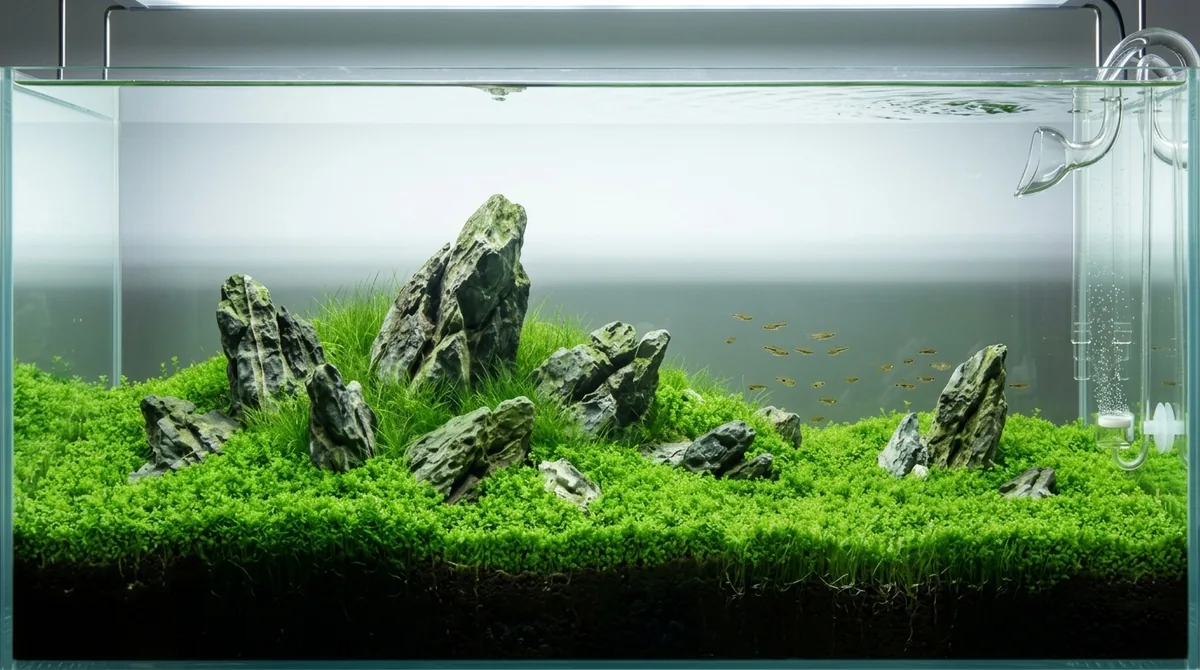
The Honest Cost of Going High-Tech
High-tech isn't the try-hard choice. It's the honest one — for a keeper whose daily capacity actually matches it.
Low-tech planted tanks get called the honest choice on this site, and that's true — for a keeper whose capacity is modest. It was never meant to say the opposite about high-tech. A CO2-injected, high-output, competition-grade layout is just as honest a choice, for the keeper whose actual daily bandwidth matches what it demands.
This one is for that keeper. What "high-tech" actually costs day to day, where even real discipline can still drift out of alignment, and how to tell genuine capacity from a pull that's still mostly aesthetic.
Not a graduation. A different capacity.
High-tech is often described as the tier a keeper "graduates" into once they're serious enough. That usually means CO2 injection, high-output lighting, a dosing schedule, a layout built toward a competition standard. That framing gets the relationship backwards. It isn't a more advanced version of the same commitment. It's a different commitment altogether, with a narrower margin for error across nearly every rhythm at once.
Nothing about that makes it less honest than a low-tech tank. A low-tech setup is aligned when its demands match a keeper's actual, modest capacity. A high-tech setup is aligned by exactly the same test — it just requires a much higher capacity to pass it. Neither one is the "real" version of planted-tank keeping that the other is a lesser substitute for.
What follows isn't a case for going high-tech, or against it. It's what the honest version of that choice actually requires, so the decision gets made on real information instead of on how a finished layout looks in a photo.
More inputs, not more forgiveness
CO2 injection needs daily attention, not a one-time setup. A drop checker or bubble count has to be read and adjusted often enough to keep levels high enough to matter. It has to stay short of the range that stresses fish overnight, when photosynthesis stops pulling CO2 back out of the water. High-output lighting cuts the other way. A photoperiod that runs even slightly too long, on a tank already running rich in nutrients and carbon, is one of the fastest routes to an algae outbreak. This site's own diagnostics cover that pattern.
Dosing follows the same pattern. A high-tech planted tank growing at real speed needs nutrients replaced on a tight, near-daily schedule, not topped up whenever it's convenient. Fast growth also means fast maintenance: carpeting plants and stem plants under strong light and CO2 can need trimming weekly, not monthly. A missed trim doesn't just look untidy — it shades out the layer beneath it fast enough to change the tank's whole trajectory within days.
None of this makes a high-tech tank more "automatic" once it's dialled in. It asks for more precise attention across more variables, on a schedule with less room to slip, than a low-tech tank ever does. That isn't a criticism of the style. It's the actual shape of the commitment, stated plainly instead of implied by a finished photo.
"A high-tech tank doesn't reduce how often a keeper needs to show up. It raises how precisely they need to, across more things, at the same time."
A high capacity still has an edge
Real discipline doesn't make a keeper immune to misalignment. It just moves the failure point higher up. A layout built toward a contest deadline can look camera-ready while the ecology underneath it is still young and unsettled. That's the same gap this site covers as false maturity — just reached through more skill and effort rather than less. A tank that passes on photos the week of a submission isn't the same as a tank that's actually stable.
The pull toward a striking layout can also start to outrank the needs of what's living in it. A plant or fish gets chosen because a composition needs that exact shape or colour there. It isn't chosen because it's a good fit for the water it will actually live in. That's the same instinct this site names elsewhere when livestock gets treated as a design element instead of an animal with its own requirements. Here it just arrives through genuine craft instead of careless staging.
Capacity creep applies at the top of the range too. One demanding tank, run by a keeper who has genuinely built the bandwidth for it, can be entirely sustainable. Chasing that same intensity across several tanks at once can eventually outrun even a real, hard-earned capacity. So can pushing one tank's precision higher every season with no ceiling in mind. It's the same pattern this site tracks in keepers with far more modest setups — just with a much higher number before it shows up.
The pull and the bandwidth are two different things
Wanting a high-tech tank and having the standing capacity for one aren't the same thing. The gap between them is easy to miss from inside the excitement of planning one. A useful honest check: could this dosing and monitoring schedule survive a genuinely busy, unmotivated month, not just the first few weeks when everything is new. Would the patience for slow ecological maturity hold up without a deadline or an audience pushing it. Neither question has a right answer — they're just the difference between an aligned yes and a hopeful one.
A pull that's mostly aesthetic and not yet backed by that kind of standing bandwidth isn't a failure, and it isn't a smaller ambition. It's usually the early signal of capacity that hasn't been built yet. That's the same starting point most high-tech keepers actually had, whether or not it shows up in how they talk about it now.
Where a low-tech tank fits into that isn't as a lesser stop on the way to the real thing. It's a genuine, complete way to build the daily habits — reading water, reading plants, staying consistent without excitement to carry it. A high-tech tank will later ask for those same habits, just at a much higher volume. Read honestly, both are the same practice. They're just tuned to different capacities.