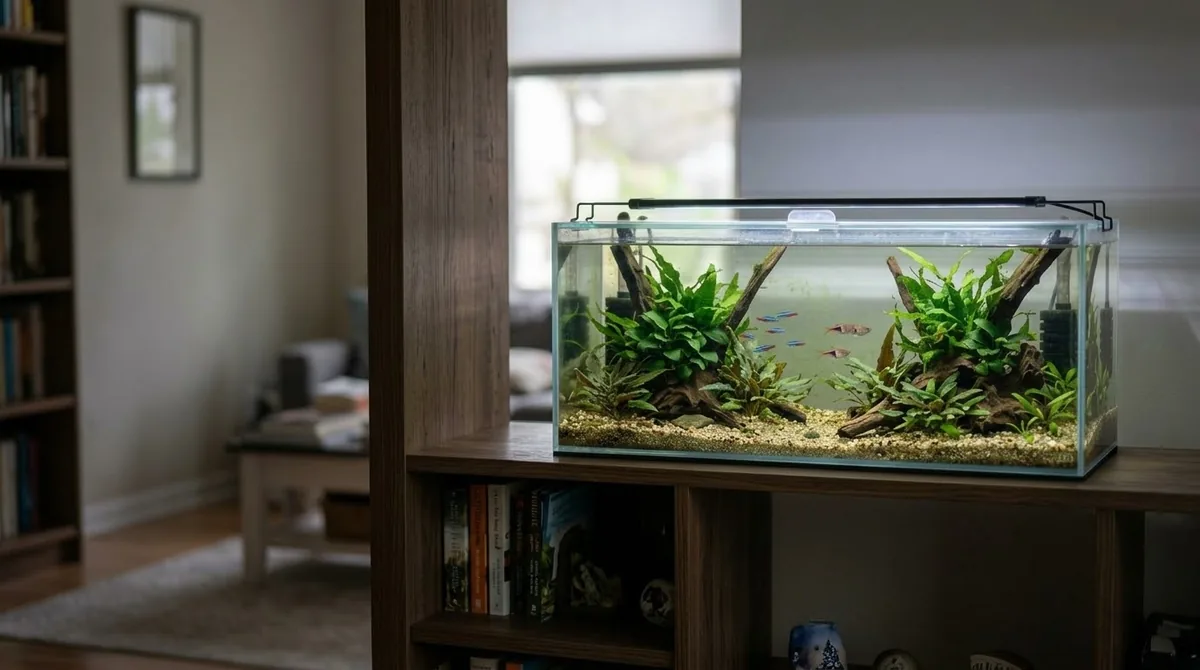
How to Start a
Low-Tech Planted Tank
Low-tech is not the budget choice. It is the honest one.
The low-tech planted tank is often framed as a compromise — something you graduate out of when you are ready for CO2 injection and high-output lighting. That framing is wrong.
A low-tech tank is a tank whose demands match the keeper's actual capacity. This guide walks through what that means ecologically, which plants align with an honest keeper rhythm, how light functions as Environmental Rhythm, and why starting small is the most aligned path.
What "low-tech" actually means ecologically
Most hobbyists think of low-tech as the budget option: no CO2 injection, cheaper lights, simpler substrate. In ARA terms, low-tech is something more meaningful — it is a planted tank whose demands fall within the keeper's actual capacity.
High-tech planted tanks (pressurised CO2, high-output lighting, regular dosing) are not harder because the plants are picky. They demand a different kind of capacity: technical fluency to set up and calibrate CO2 systems and dosing equipment correctly, ongoing maintenance of that infrastructure, and enough observation to recognise when automation is performing correctly and when it is not. A keeper who has genuinely built this technical capacity — understands their system, maintains their equipment, monitors outputs — can sustain a high-tech planted tank in honest alignment. Automation handles much of the daily routine; the keeper's role shifts from manual consistency to technical understanding and active monitoring.
A low-tech tank reduces the gap between what the plants need and what the keeper can realistically provide through manual care. For keepers whose natural rhythm is manual and who have not built the technical infrastructure a high-tech tank requires, this is not a compromise. It is the correct alignment.
Understanding what you can actually sustain matters more than what you'd like to build — and capacity includes technical infrastructure, not just time and attention. A high-tech tank managed without the technical understanding and maintained equipment it requires will drift toward decline. A low-tech tank maintained consistently — even imperfectly — will almost always succeed. The honest starting point is what kind of capacity you've actually built, not just what you intend to provide.
Plants that match an honest keeper rhythm
Not all aquarium plants have the same demands. Some require CO2, high light, and precise nutrient balance to do anything at all. Others have evolved in low-light, fluctuating environments and will grow in almost anything stable. The key is matching plant selection to keeper rhythm — not to aquascape aspiration.
Rhizome plants (Anubias, Java Fern, Bucephalandra): Attach to hardscape, do not need substrate nutrients, grow slowly, tolerate low-to-medium light. Cannot be planted in substrate — the rhizome will rot if buried. Extremely forgiving of inconsistent fertilisation, and among the most aligned plants for a keeper whose rhythm involves longer gaps between maintenance.
Stem plants with low demands (Hygrophila polysperma, Limnophila sessiliflora, Vallisneria): Grow in substrate, do well under moderate light without CO2, benefit from occasional liquid fertiliser. Fast-growing, which helps outcompete algae by consuming excess nutrients before they become an Environmental Rhythm problem.
Floating plants (Salvinia minima, Frogbit, Duckweed): No substrate needed, fast growth, absorb nutrients directly from the water column, and reduce light reaching lower plants — useful if algae is appearing and nutrients need somewhere else to go. Excellent for low-tech because they are self-regulating and respond visibly to changes in nutrient load.
Plants that reveal misalignment in low-tech (Glossostigma, HC Cuba, many foreground carpets): These require CO2 and high light to remain alive. In low-tech conditions they decline slowly and create an algae problem as they release nutrients during decay — a compounding misalignment rather than a simple absence of growth.
Beauty isn't really the question worth asking about a plant. Survival at three months, given the care you can actually give, is.
Light as Environmental Rhythm, not just fixture
In a planted tank, light is the primary driver of the Environmental Rhythm. The question most keepers ask is "how many lumens?" or "which LED brand?" In ARA, the more important question is: how consistent is the photoperiod?
Plants evolved with a predictable daily light cycle. Inconsistency — turning lights on at different times, skipping days, varying intensity — disrupts the Environmental Rhythm more than insufficient light does. A planted tank that gets 6 hours of consistent light daily will outperform one that gets 10 hours on some days and nothing on others. The drift introduced by an inconsistent photoperiod registers in the plants before it becomes visible to the keeper.
For low-tech, the practical guidance: use a timer. 6–8 hours per day, same time every day. Moderate-output LED (PAR 20–50 at the substrate for low-light plants). Do not raise intensity to compensate for plant problems — this almost always produces an algae response before it helps plants. If plants are not growing as expected, the first question is photoperiod consistency, not intensity.
Plants are synchronised to their light cycle, not just lit by it. In nature, aquatic plants experience predictable daily cycles. A timer recreates that predictability. A manually switched light, adjusted by mood or convenience, creates drift that the plants register before you see any visible sign of it.
Starting small, reading before expanding
The most common drift pattern in low-tech planted tanks is starting with too many variables at once: new substrate, multiple plant species, new fertiliser regime, new light schedule, new fish, all in the same week. When problems emerge — and they will — it is impossible to know which variable caused them.
The aligned approach is to start with one or two forgiving species (a rhizome plant and a fast-growing stem plant) and let the tank settle before judging anything.
The first week is adjustment, not evidence — new plants can melt or pale slightly after the move, and that alone doesn't mean anything is wrong. By week two or three, look for smaller signs: new leaves coming in on the rhizome or stem plants, water staying clear, no fresh algae joining what was already there. None of these confirm the setup is right, but they're something to notice well before six weeks pass with nothing to go on.
By week four to six, read what the tank is actually telling you. If algae is appearing, light is too high or nutrients are out of balance. If plants are melting past the initial adjustment, water chemistry or temperature may be off. If growth is slow but steady and new leaves keep coming, the tank is stable at a low metabolic rate — which is exactly what a low-tech tank is designed to be.
The second aligned practice: before adding any new plant species, research its actual demands. If it needs CO2, it is not a low-tech plant regardless of what the shop says. If it needs high light, it will produce an algae response under low-light conditions as it declines. Matching plant demands to your setup — honestly — is what makes a low-tech tank succeed over years, not just months.
A stable, slow-growing planted tank is not failing. It is succeeding at a pace that matches the system it lives in.
There is a particular pressure in planted tank communities: the sense that what you are doing is a lesser version of what serious keepers do. High-tech setups get more photography, more forum attention, more detailed discussion. A low-tech tank running quietly in the corner can start to feel like evidence of limitation rather than a deliberate, calibrated choice. That comparison is worth examining. A low-tech tank that matches the keeper's actual rhythm — their available time, their honest maintenance pattern, their capacity for complexity — is not a compromise. It is alignment. A high-tech tank that requires more than the keeper can reliably give is the less stable of the two, regardless of how it photographs.
The degree to which automation, monitoring systems, and equipment design can perform routine care functions reliably is real capacity. Well-understood and properly maintained equipment genuinely extends what a keeper can sustain. But automation installed without genuine understanding becomes a liability — when systems fail silently or mask signals, the equipment meant to help buffers you from the information you actually need. That's not an argument against automation — it's a reason to stay a little curious about it, even once the routine feels handled.