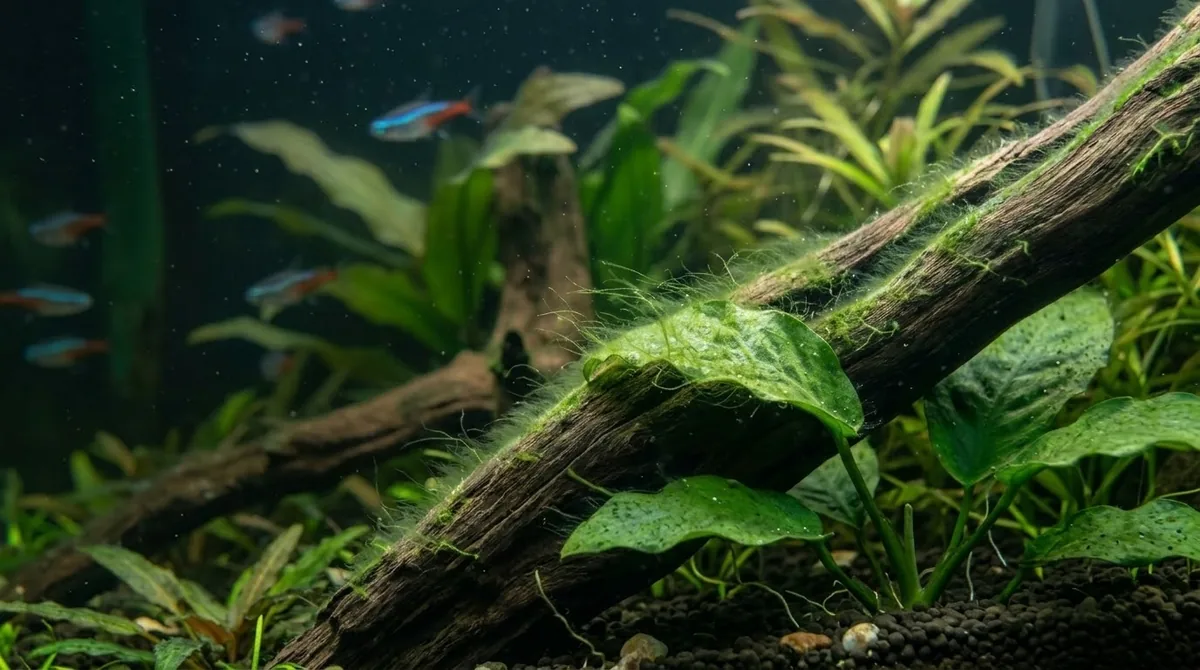
Algae in My Aquarium —
What It's Actually Telling You
Algae is not the problem. It is the reading.
Algae grows in every aquarium, at every experience level, under every care pattern. The tank is not broken. The keeper has not failed. Something in the conditions has created an opening, and algae has moved into it.
This guide walks through the most common types and what each one signals about your Environmental Rhythm. It also covers what actually changes things, as opposed to what simply removes the visible symptom until it returns.
Not all algae
is the same signal.
Algae grows in every aquarium, at every experience level, under every care pattern. That fact alone should shift how it is approached. It is not a sign that the tank is dirty or that the keeper is failing. It is a sign that certain conditions exist, and different types of algae point to different conditions.
Brown dusty film (diatoms). Almost always appears in new tanks in the first one to four months. This is normal Early Phase behaviour — silicates in fresh substrate and tap water feeding a temporary bloom. It usually disappears on its own as the tank matures. Wiping it down accelerates the cosmetic effect but does not change the underlying timeline.
Green spot algae — hard green dots on glass and hardscape. Appears when light intensity is high or photoperiod is too long for the nutrient level in the water. Common in tanks with good lighting but no or few plants to compete for nutrients.
Hair algae / filamentous algae — stringy, green, catches on plants. Often indicates excess nutrients (nitrate, phosphate) combined with inconsistent CO2 levels if plants are present. Can also grow with high light and low plant density.
Green water — pea soup cloudiness. A phytoplankton bloom, often triggered by direct sunlight hitting the tank or a combination of high nutrients and high light. Not harmful to fish but visually disorienting.
Black beard algae (BBA) — dark tufts on plant edges and hardscape. Almost always linked to CO2 fluctuation in planted tanks, or very slow water flow in specific areas. One of the more persistent types.
Blue-green algae / cyanobacteria — slime-like, bluish-green, with a distinctive smell. Not true algae — it is a photosynthetic bacteria. Signals very low nitrate (often after heavy water changes or very low bioload) combined with excess phosphate, or low-flow dead spots.
"Before asking how to get rid of it, ask what type it is, and what it's actually reading in your tank."
If you've read guides that flatly contradict each other here — one says cut nutrients, another says dose more — you haven't misunderstood anything. That disagreement is real, and it runs through the hobby itself, not just through inexperienced advice. One school treats algae as a direct response to excess nutrients. Another, the Estimative Index approach common among experienced planted-tank keepers, deliberately doses well above what plants strictly need, on the reasoning that a nutrient-starved plant is too weak to compete — and it's the weak plant, not the nutrient level, that lets algae in.
Both approaches get real results, because they're solving the same problem from different ends: getting plants healthy enough to out-compete algae for light and CO2. For green spot, hair algae, and green water specifically, there's no single settled answer for exactly which nutrient is too high or too low. What's more reliable than chasing a number is watching whether light, CO2, and nutrients are moving together — not whether one of them matches a chart.
Algae grows where
conditions let it.
In Aquatic Rhythm Alignment, algae presence is primarily a signal about Environmental Rhythm misalignment. Specifically, it points to the relationship between light, nutrients, and plant density in the system. These three things exist in a dynamic balance. Algae enters when that balance tips: when light is more than plants can use, when nutrients accumulate faster than they are consumed, when conditions are consistent enough for algae to establish but inconsistent enough to stress plants.
The key insight is that algae and plants are competing for the same resources. In a well-balanced planted tank with appropriate light and nutrients, algae rarely establishes because plants win the competition. In a tank without plants, or with plants that are struggling, algae fills the available niche. It is not intruding. It is responding to what is there.
The persistence question matters too. Algae that appears and then fades is often a phase event, like diatoms in a new tank, or a one-time drift that corrected itself. Algae that keeps returning despite removal is telling you that the underlying condition is still present. Scraping the glass does not change what is in the water or how long the lights are on. The algae is reading conditions that have not changed. So it returns.
Light cycle consistency, temperature stability, flow patterns, and the nutrient balance of the water form the background condition that either supports or undermines everything else in the tank. Persistent algae is almost always a sign that one of these is off, not that the tank is poorly maintained.
Removing algae
does not remove the condition.
The most common response to algae is physical removal: scraping, blackout periods, algaecide. These approaches address the visible symptom without addressing the condition that produced it. If the light cycle is still too long after the blackout, algae returns. If nutrients are still accumulating faster than plants consume them, hair algae regrows within weeks. The condition is patient. It will wait.
What actually changes things is finding the misalignment and adjusting it. For most algae types, this means one of the following:
Reducing photoperiod: the most common aligned response for green spot algae and hair algae. If the lights are running 10 or more hours, try 7–8 hours with a midday break. Most planted tanks thrive on less light than keepers assume.
Adding more plants: the most ecological response available. More plants means more competition for the resources algae needs. Fast-growing stem plants in particular can shift the balance quickly by consuming nutrients before algae can use them.
Reducing feeding: relevant in tanks without live plants. Less organic input means less nutrient accumulation. Small, consistent reductions are easier to read than sudden changes.
Improving flow to eliminate dead spots: particularly relevant for black beard algae and cyanobacteria, which tend to establish in areas where water movement is low and conditions are stagnant.
Patience with diatoms: brown film in a new tank does not need intervention. It resolves with tank maturation. Wiping it helps cosmetically, but the underlying silicate bloom runs its own timeline.
One important note: do not change multiple things at once. If you reduce photoperiod, add plants, and change feeding all in the same week, you will not know what worked. You may also disrupt the system further. One change, observed over time, gives you legible feedback.
"The goal is not a tank without algae. It is a tank where the conditions no longer consistently favour algae over everything else growing there."
What you're seeing on the glass is the visible result. The lighting, flow, or nutrient imbalance that produced it is the actual cause. Removing algae addresses what you can see; adjusting the condition that produced it addresses why it's there. When the underlying condition is unchanged, the algae returns, reliably and predictably, because nothing has actually changed for the tank.
Identify the type.
Adjust one thing. Then watch.
The practical path forward is straightforward, even if it requires patience rather than speed.
First, identify which type of algae you have. Use the descriptions in module one as your reference. Then match it to the most likely Environmental Rhythm misalignment: diatoms point to tank age; green spot and hair algae point to light and nutrients; BBA points to CO2 fluctuation or low flow; cyanobacteria points to very low nitrate or dead spots. From there, make one change: the most likely correction for your specific type.
Then wait two weeks before assessing. Algae does not respond overnight, and neither does the correction. A change that appears to have done nothing after four days may have already shifted the balance; you will see it in week two.
If you have multiple types present, start with the most dominant. They often share a root cause; address that, and secondary types frequently reduce on their own.
What not to do: adding algae-eating fish or snails without addressing the root condition tends to create maintenance cycles. Add algae eaters, run out of natural algae, need to supplement feeding for them, algae returns. Algae-eating species can be a genuinely helpful part of a balanced system, but they are not a substitute for Environmental Rhythm alignment. They work best when the conditions are already moving in the right direction.
The Environmental Rhythm module in The ARA Framework covers light, temperature, and flow as ongoing systems, not just setup decisions. It is the longer read that sits behind everything in this guide.
Algae carries more shame than almost any other aquarium problem. The clean, clear tanks in photographs do not have it. The advice columns treat it as something to be eliminated. The experience of finding hair algae on the glass or black beard algae on a favourite piece of wood can feel like evidence of poor keeping — a visible failure on display. That shame is worth examining, because it tends to produce the least effective responses: panic scrubbing, multiple simultaneous interventions, or a sense that the hobby is harder for you than it is for others. Algae is a condition read, not a verdict. Every tank produces the conditions for some type of algae at some point. The useful question is not "why do I have algae" but "what is out of balance right now."