False
Maturity
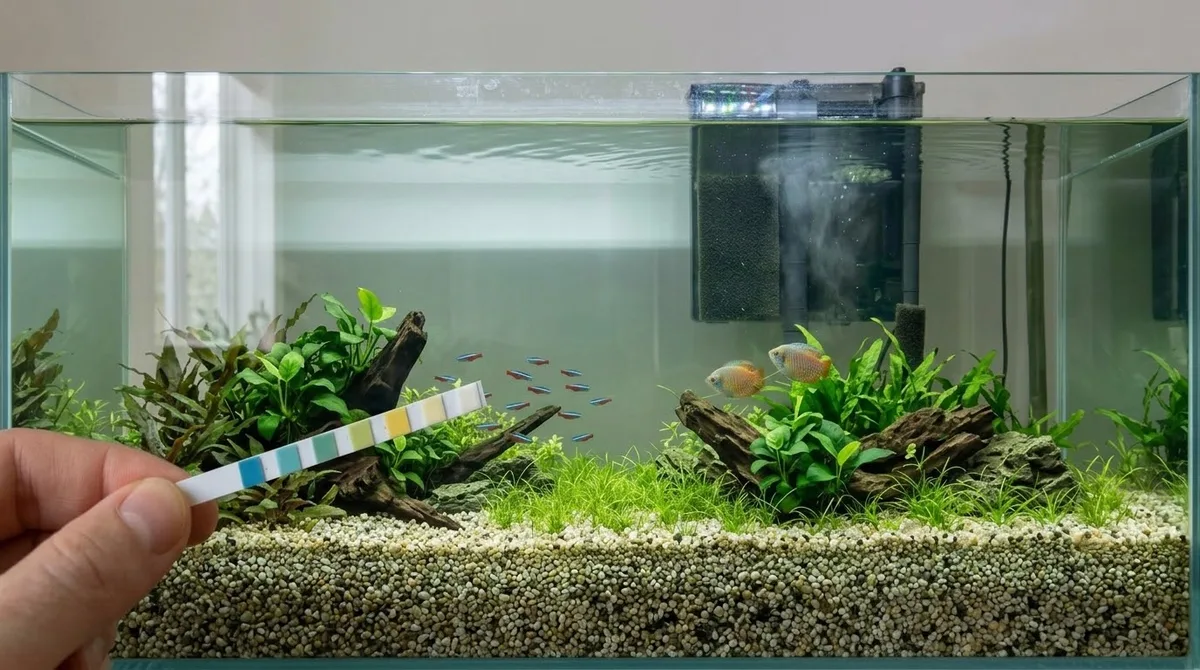
A tank can pass every test on the strip and still not be ready for a single hard day.
Some tanks look mature almost from the start. Ammonia at zero, nitrite at zero, nitrate low and steady, week after week. To a keeper checking test strips, this looks like exactly what a healthy, settled tank should look like — and often it is. But sometimes it isn't, and the gap between the two can stay invisible for a surprisingly long time.
False maturity is what ARA calls a tank that reads as stable on the numbers but hasn't actually built the ecological depth real stability depends on. It isn't a rare edge case. It's a predictable outcome of a few very common, very reasonable-looking setups, and it tends to surface at the worst possible moment: the first time the tank is actually asked to absorb a disruption.
Passing every test isn't the same as being resilient
A genuinely mature tank has more going on than a clean set of readings. Its nitrogen cycle isn't just functional, it's redundant, processed by a broad, well-distributed bacterial community living across the filter, the substrate, the hardscape, even the glass. Its substrate has its own microbial activity. If it's planted, root systems have knitted into that biology. The whole system has accumulated a kind of depth a snapshot test can't measure. A test kit only reports the output of that depth, not the depth itself.
A false-mature tank can produce the exact same output, zero ammonia, zero nitrite, tidy nitrate, without any of that underlying structure. The numbers are a symptom of stability, not proof of it. Two tanks can read identically on a test strip. One has months of accumulated ecological resilience behind those numbers. The other has almost none.
This is why false maturity is genuinely hard to catch early. There's no single reading that flags it, no obvious symptom while things are going well. The tank behaves exactly like a mature tank should, right up until it doesn't.
"A test kit reports what the biology is currently producing. It has no way to report how much of that biology actually exists. Two tanks can look identical on the numbers and be nowhere close to equally resilient."
Three common paths into false maturity
False maturity isn't caused by neglect. It usually comes from setups that look, on paper, like careful keeping. The first path is light stocking paired with heavy filtration. A tank with few fish and an oversized filter processes the nitrogen load so efficiently that the biology never has to develop much depth to keep the numbers clean. The filtration is doing the work a broader ecosystem would otherwise be building toward.
The second path is very frequent, very large water changes. Diluting nitrate before it accumulates keeps the readings tidy. But it also strips out the biological inputs that deeper biology actually develops in response to, things like dissolved organics, trace nutrients, and the slow chemical signature of an established system. A tank changed at fifty percent every other day never gets the chance to accumulate the history a mature tank runs on.
The third path is skipping or rushing the Early Phase itself. That might mean a tank seeded so heavily at setup that the cycle completes almost immediately, or a tank left running fishless for a year with no biological load to respond to. In both cases, the tank arrives at "zero ammonia, zero nitrite" without ever going through the developmental process that normally produces that result.
Heavy filtration, frequent water changes, and careful fishless cycling are all legitimate techniques. False maturity isn't a punishment for using them. It's what can happen when they're relied on so completely that the tank never needs to develop its own depth alongside them.
Read the response to disruption, not the reading itself
Because false maturity can't be seen in the numbers, it has to be read a different way, through how the tank responds when something actually happens to it. A genuinely mature tank absorbs a moderate disruption, a missed water change, a small temperature swing, a slightly heavier feeding, without much visible reaction. The parameters barely move. Or they move and recover within a day or two, because there's enough biological depth to buffer the change.
A false-mature tank responds differently. The same missed water change produces a real ammonia bump. The same small temperature swing triggers visible stress in the fish. The same disruption a mature tank shrugs off becomes, in a false-mature tank, the first sign anything was ever wrong. By the time this happens, the keeper is often caught off guard, because everything had been reading perfectly for months.
This is closely related to phase regression. A tank can slip backward toward earlier-phase behaviour under enough stress. A false-mature tank is essentially already there, just without having been through a visible regression first. It never had the resilience buffer that phase regression describes losing. It simply never built one.
Treat it as still developing, because it is
If a tank shows signs of false maturity, the aligned response is not alarm. It's a recalibration of what phase the tank is actually in. A false-mature tank isn't Mature Phase with a problem. It's a Developing Phase tank that happens to read clean. It benefits from the same things any Developing Phase tank needs. Gradual additions, rhythm consistency, and time let the biology catch up to what the numbers have been claiming all along.
In practice, this usually means easing off whichever mechanism was carrying the load. If frequent large water changes were the cause, the fix is to space them out slightly while watching nitrate more closely than before. That gives the biology room to start doing more of the work itself. If heavy filtration relative to a light bioload was the cause, there's often nothing that needs correcting at all beyond patience. The depth builds on its own timeline as the tank simply keeps running.
This is worth distinguishing clearly from a tank that has genuinely arrived. A truly stable tank benefits from being left alone. A false-mature tank benefits from being watched more closely, for exactly the kind of small disruption that would otherwise arrive as a surprise. That isn't because it needs more intervention. It's because it hasn't yet earned the kind of trust that stops looking like trust and starts looking like neglect.
It's tempting to read a clean set of numbers as permission to stop paying close attention, the way a genuinely stable tank rewards that instinct. A false-mature tank is the exception: the numbers are asking for trust it hasn't built yet.