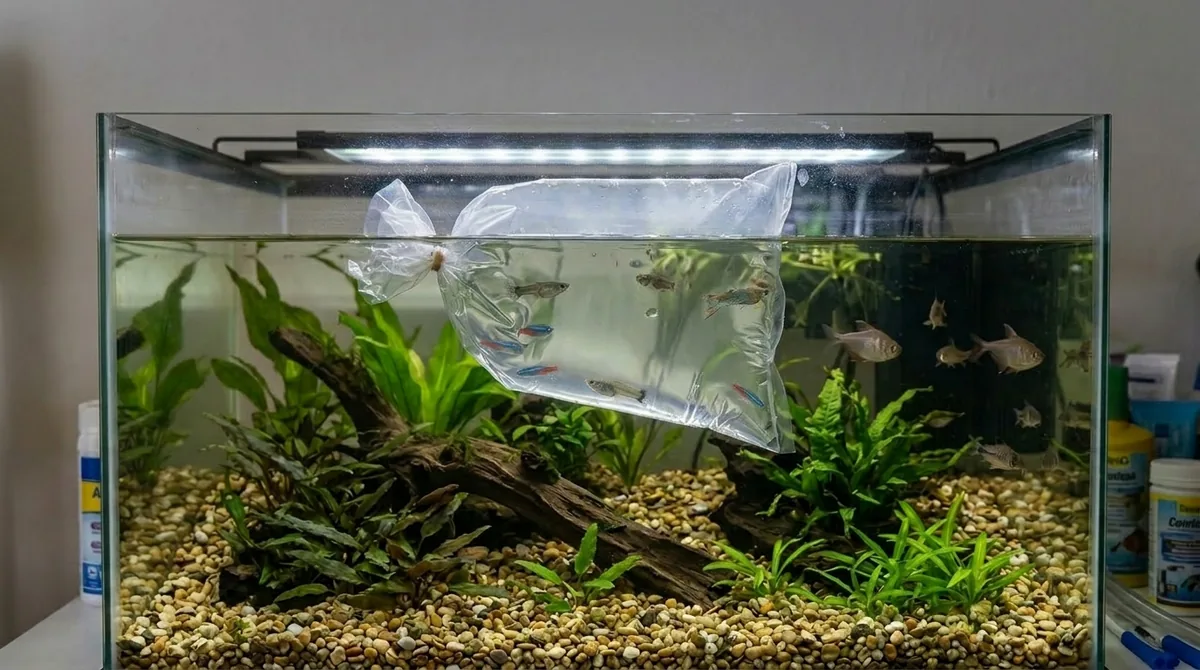
Adding New Fish
The Disruption Window
The first two weeks are a disruption. That is normal.
You added the new fish properly — drip acclimation, matched temperature, the bag floated for 20 minutes. But three days later the existing fish look stressed, one is hiding who never used to hide, and the new arrivals aren't eating. You did everything right. The disruption happened anyway.
This guide explains why adding new fish always disrupts a stable tank, what the two-week disruption window looks like across all five rhythms, and how to read what's happening — rather than rushing to fix what doesn't need fixing.
Why every addition is a disruption
A stable aquarium is a negotiated equilibrium. The fish have established territories, feeding hierarchies, and social patterns. The bacterial colony in the filter is sized to the current bioload. The water chemistry reflects the balance between what the tank produces and what the maintenance rhythm removes.
When new fish arrive, all of this is disrupted simultaneously. The bacterial colony faces a higher bioload than it was sized for — new fish add waste before the bacteria can expand to process it, which means ammonia and nitrite may nudge upward for days or weeks. The existing fish perceive the new arrivals as intruders, triggering territorial and social responses that look like aggression, hiding, or colour changes. The new fish are stressed from transport, unfamiliar water chemistry, and an unfamiliar social hierarchy — which suppresses their immune response during exactly the period they most need it intact.
None of this is a problem. It is a disruption — a temporary state that a healthy tank with aligned keeper rhythm passes through. The disruption window is not a signal to act. It is a signal to watch.
"A disruption is not a crisis. It is the tank reorganising around new information. The aligned response is observation — not intervention."
Adding new fish disrupts more than just the newcomer's corner of the tank: the bacterial colony adjusts to a new bioload, water chemistry shifts slightly, territory reorganises, and existing fish respond socially — all at once. That disruption is expected; it's how the system absorbs new information. The best response is observation: wait for the tank to settle back into its own equilibrium before intervening.
Quarantine: what it actually protects
Quarantine is often described as protecting existing fish from disease brought by new arrivals. That is true, and it is the practical reason to maintain a quarantine tank. But quarantine also protects the new fish. A fish introduced directly into an established community tank is navigating a new social hierarchy, unfamiliar water parameters, and potential territorial aggression while simultaneously stressed from transport. If that fish is carrying a low-level infection — ich, bacterial infection, internal parasites — the combination of stressors may trigger an outbreak in the new fish and then expose existing fish whose immune function is suppressed by the territorial disruption.
A two-week quarantine does three things: it allows the new fish to recover from transport stress in a calm, uncontested environment; it gives time for any carried disease to manifest where it can be treated without affecting the display tank; and it allows the keeper to observe the new fish's behaviour, appetite, and colouration at baseline before introducing them to the social complexity of the main tank.
A quarantine tank does not need to be elaborate — a bare 20–40L tank with a cycled sponge filter, a heater, and a simple hide is sufficient.
Quarantine isn't just disease prevention — it's a chance to read the fish. Watching a new fish eat, swim, and rest in an uncontested environment tells you what their baseline looks like. That baseline is what you compare against once they enter the display tank.
Reading the two-week window
The two weeks after introduction are the disruption window — the period during which the tank is reorganising. What to expect and how to read it: territory negotiation looks like chasing, fin-spreading, and occasional nipping. In community fish without dedicated territories, this usually resolves within days. In cichlids or bettas, the negotiation is longer and more physical. Watch for sustained chasing (one fish unable to access food or rest), clamped fins that don't resolve, or hiding that continues beyond five to seven days — these are signs the social disruption is not resolving on its own.
Parameter drift during this window is expected. Test ammonia and nitrite for the first ten days after adding new fish — not because a crisis is likely, but because the bacterial colony is adjusting to a new load. A small ammonia reading (0.25 ppm) that clears within 24 hours is the colony catching up. A reading above 0.5 ppm that doesn't fall within 24 hours is the colony struggling and warrants a water change.
New fish not eating for the first two to three days is normal — they are stressed and orienting. Not eating past five to seven days warrants attention. Observe before acting. Most disruptions resolve without intervention if the keeper rhythm (feeding, water changes) remains consistent during the window.
"The disruption window asks one thing of the keeper: consistency. Keeping the feeding schedule, lighting, and water change rhythm stable through this period is the highest-value thing to do — the biology is already working hard without any new variables added."
The hardest part of the disruption window is watching fish hide or look stressed and sitting on the impulse to do something. We tend to equate visible problems with the need for visible action. But the two-week window is a test of a different kind of keeping — staying the course when the tank looks unsettled. That restraint is itself an active decision. It's one of the more counterintuitive things this hobby teaches.
After the window
By the end of week two, a tank that was healthy before the addition should be returning to its baseline. Aggression decreases as territories are established or accepted. Feeding resumes normal patterns. Ammonia and nitrite return to zero. The new fish begin to show their resting colouration rather than the stress-muted tones of the first few days.
If the tank has not returned to baseline by three weeks, something in the disruption window was not a temporary reorganisation — it is a persistent condition. Sustained aggression at three weeks suggests an incompatibility that time won't resolve: the stocking configuration may need reconsideration. Ongoing ammonia at three weeks suggests the bacterial colony is not keeping up with the new load: either the tank is overstocked, or a filter issue needs attention. Continued not eating at three weeks is a disease signal, not a stress signal.
The two-week disruption window is a reading tool. It tells you what the tank can absorb, how the existing fish respond to change, and whether the new arrivals were genuinely compatible with the environment they entered. Tanks that pass through the window cleanly are telling you something useful about their resilience. Tanks that don't resolve within three weeks are telling you something equally useful about their limits.
Not all phase transitions represent failure. A keeper may deliberately reset a system — to treat a persistent illness, reconfigure a setup, or start a new cycle after a crash. That's different from a crash-driven regression: a reset is a keeper decision, not a system breakdown. The tank moves through its early stage again, subject to the same developmental arc — but the keeper's accumulated knowledge shapes how the new cycle is managed.