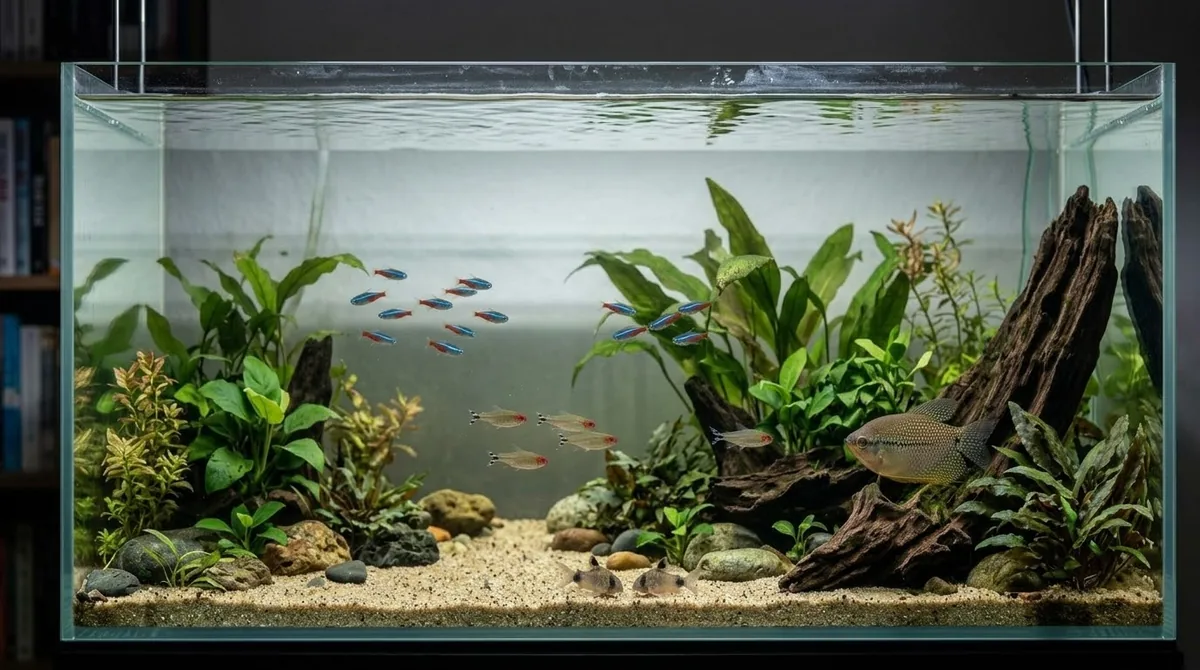
Community Fish Tank —
Who Actually Gets Along
Compatibility is not just about species. It is about the rhythms they bring together.
The compatibility chart said it would work. You stocked the tank carefully. Now one fish is always hiding, another looks thinner than it should, and the tank feels tense in a way that is hard to name.
This guide explains why compatibility charts answer only the minimum question — and how reading the Livestock Rhythm across the whole community reveals what is actually driving the drift.
Beyond the compatibility chart
Compatibility charts answer one question: will these fish attack each other? That is a useful minimum. But most community tank problems do not come from direct aggression — they come from chronic, low-level stress that accumulates when fish with different ecological needs share a space.
A fish from a fast-moving, oxygen-rich river is not compatible with a fish from a slow, heavily planted blackwater stream — not because they will fight, but because no single water parameter can satisfy both. A fish that is a mid-water open swimmer is not compatible with a fish that needs territory at the same level — not because they are listed as aggressive, but because one will spend energy claiming space the other also needs.
Compatibility charts miss this entirely. In ARA, compatibility is a Livestock Rhythm question: when you add these species together, do their combined rhythms — their ecological needs, social patterns, activity levels, and space requirements — produce a system that can hold together? Or does combining them create a background level of stress that slowly suppresses every fish in the tank?
"The fish that are slowly declining in your community tank are not incompatible. They are chronically stressed by something the chart didn't mention."
Livestock Rhythm and social ecology
In ARA, the Livestock Rhythm in a community tank is not the state of any single fish — it is the pattern across the whole group. A community tank that is working looks like this: fish occupying their expected zones, showing consistent colour and appetite, no individual consistently hiding or being chased, spawning behaviour or courtship in fish that do it, gradual weight gain across the whole population.
A community tank that is drifting looks like this: one or two fish consistently thin despite eating, a species that was active now spending time near the bottom, increased hiding especially around feeding time, fin damage appearing gradually.
The social dynamics of a community tank are driven by a few key variables:
Territory and zone overlap: Fish that need the same physical space will compete for it even if they never visibly fight. Cichlids that are nominally "peaceful" will establish territories that stress other bottom-dwellers. Too many fish of the same mid-water species creates a crowd that none of them can escape.
Feeding competition: Fast fish eat before slow fish. Messy eaters cloud the water with particles that stress fish with sensitive gills. Surface feeders out-compete mid-column feeders. If one species always has round, full bellies and another always looks thin, the feeding dynamic is likely the pressure driving it.
Size disparity over time: Fish grow. A 2cm juvenile and a 6cm juvenile are compatible today. At 4cm and 12cm, one is a predator and one is prey. Stocking a community tank based on current size rather than adult size is one of the most common causes of community breakdown six months in.
Activity level mismatch: A highly active, fast-moving schooling fish (danios, barbs) creates a hyperactive environment that stresses slow, deliberate fish (bettas, gouramis, many catfish). The active fish aren't doing anything wrong — they are just creating an ecological pace that the slower fish find persistently aversive.
In a community tank, watch the group as a whole — not just whether any one fish looks visibly sick. A community where some individuals thrive while others slowly decline has an unresolved pressure somewhere. Find which fish are thriving and which are declining — the pattern will usually point to what's off.
Finding what's driving it
In a community tank, the underlying pressure is usually one of three things: a species mismatch, a stocking density problem, or a single individual causing outsized stress. Finding it requires observation over time, not a single snapshot.
The ARA approach: for one week, observe the tank at the same time each day — ideally at feeding time and once at night. Note which fish are actively feeding, which are hanging back, which are occupying which zones, and whether any individual is consistently chasing others. At the end of the week, the pattern usually makes that pressure visible.
Common findings:
A single male of an otherwise peaceful species is the only fish causing chasing — removing him resolves the whole tank.
One species is consistently outcompeting others at feeding — target feeding with a separate pipette resolves the issue without removing anyone.
A species listed as "community safe" is demonstrably not compatible with the specific other species in this tank — not because the chart is wrong, but because individual temperament and tank size change the dynamic.
The tank is overstocked — not catastrophically, but enough that there is no neutral territory for any fish to withdraw to.
"Observation for one week reveals more about a community tank than a compatibility chart and a water test combined."
One of the more uncomfortable experiences in keeping a community tank is watching a fish you care about get thinner or more withdrawn, and feeling unsure whether to intervene or wait. The week of observation described above can feel like doing nothing — but it's actually the most information-efficient thing you can do. What you see by the end of that week is something a compatibility chart can never give you: how this specific group, in this specific tank, actually behaves together.
Reading your community before adding to it
The most important principle for a community tank is one that the hobby rarely states directly: do not add fish to a struggling community to solve the problem. A tank where some fish are hiding, where one species is thin, where aggression is present — this is a tank that needs less, not more.
The aligned approach to adding new species is to start from a stable community. When the existing inhabitants are all active, well-fed, showing good colour, and occupying their expected zones, the tank is ready to consider new additions. At that point, the question to ask before adding any new species is: what does this fish need that my tank already provides? — water temperature, flow rate, hiding spots, feeding zone, social group size (many species need to be kept in groups of 6+).
If the answer is "everything I already have," the addition is likely aligned. If the answer is "I would need to change the temperature, add more flow, and remove the aggressive individual," the addition is not aligned — no matter how beautiful the fish is.
The most successful community tanks are usually modest in species count and generous in space per fish. A 200-litre tank with four carefully selected species will almost always outperform a 200-litre tank with twelve species "from the compatibility chart."
A community tank has a capacity — a number of fish, a social density, a level of ecological complexity — that it can sustain comfortably. Exceeding that capacity produces chronic stress across the system. The better approach is to find the community that thrives within the tank's actual capacity, not to push toward the maximum a chart says is possible.