The White Fuzz
on Your Driftwood
It's not mould, and it's not a mistake.
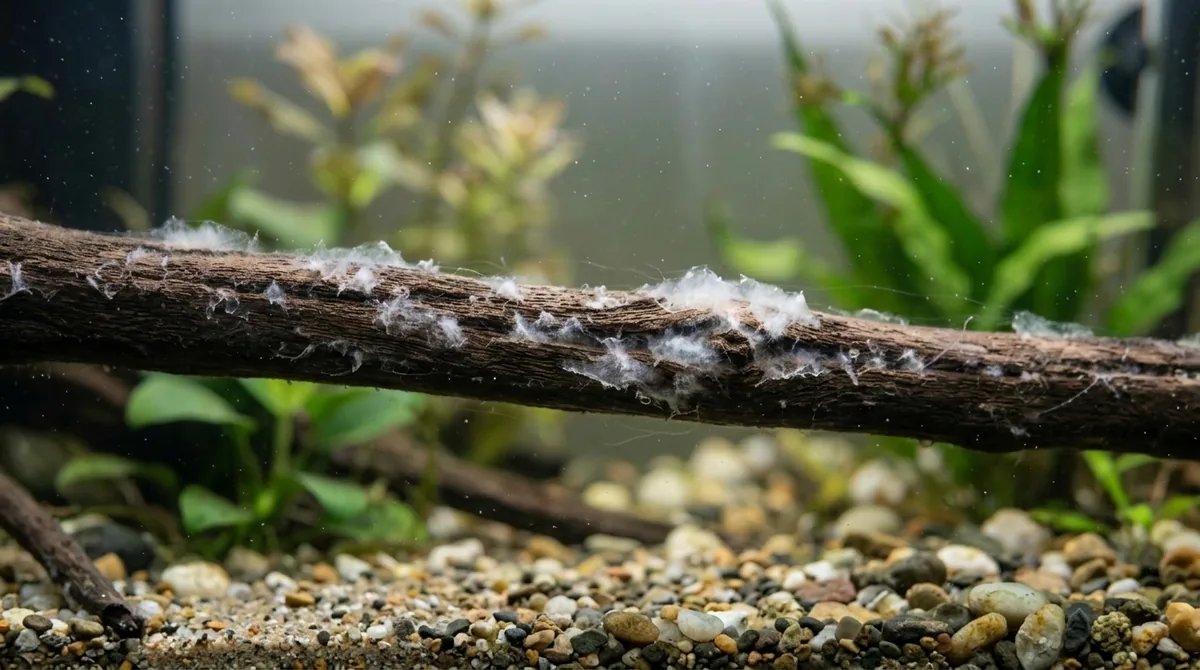
A week or two after adding new driftwood, a soft, cottony white growth appears across parts of it — sometimes patchy, sometimes covering large sections. It looks exactly like the kind of thing that shouldn't be in a fish tank.
This guide explains what that fuzz actually is, why it isn't a sign anything went wrong, and the one situation where it's worth watching more closely.
It looks exactly
like mould. That's the problem.
New driftwood in a freshly set up tank often grows a soft, white, cottony coating within the first one to three weeks. Sometimes it's patchy; sometimes it covers most of the submerged surface. Under aquarium lighting it can look startlingly like the mould someone might find on old bread, which is exactly the association that makes it alarming.
The instinct that follows is almost always the same. Scrub it off, pull the wood out and boil it again, or start looking for a water conditioner marketed to fix it. None of those responses are wrong exactly, but none of them are necessary either — and scrubbing in particular can undo something that was actually working in the wood's favour.
This growth is one of the more reliable "new tank" signals in the hobby. It's common enough that most experienced keepers barely register it anymore, and confusing enough that almost every new keeper encounters it at least once and worries.
It isn't the same thing as fungus growing on a sick fish, and it isn't the same as algae. It's a biofilm — a colony of microorganisms living on the wood's surface. Biofilms of this kind are one of the most ordinary things a closed aquatic system produces.
The wood is releasing
exactly what it's supposed to.
Driftwood isn't inert. Even after drying and curing, it still holds soluble sugars, starches, and other organic compounds inside its structure — leftovers from when it was living plant tissue. Submerged in water, those compounds slowly leach out through the wood's surface. They're an excellent, readily available food source for naturally occurring bacteria and fungi already present in any established or newly cycling tank.
The white fuzz is that colony feeding on exactly the material the wood is releasing. It's most common on wood that wasn't fully waterlogged before going into the tank. Drier wood tends to hold more of these surface-accessible sugars than wood that's been thoroughly soaked or boiled beforehand.
Because it's feeding on a finite supply, the growth follows a predictable arc. It appears within the first couple of weeks, often looks its most dramatic somewhere in that window, then thins out and disappears on its own as the wood's easily accessible sugars get consumed.
"The fuzz isn't a sign the wood is contaminating the tank. It's a sign the tank's biology found something to eat — which is closer to a working system than a failing one."
Leave it, and watch
who takes an interest.
In the vast majority of cases, the aligned response is simply to leave it alone. Scrubbing it off doesn't shorten the underlying process — the wood still has the same sugars left to release. It can also temporarily disturb the wood's surface and any beneficial biofilm that had already started establishing there. The fuzz almost always regrows within a few days after being removed, for exactly this reason.
Many shrimp, snails, otocinclus, and bristlenose plecos treat this biofilm as an actively good thing rather than a problem. It's a genuine, free food source, and tanks with these species often see the fuzz grazed down faster than it would clear on its own. If anything is going to remove it for you, it's usually the tank's own inhabitants, not a scrub brush.
The one situation that deserves closer attention is new driftwood added to an already-established, stable tank rather than a fresh setup. The decomposing surface material can shift ammonia or tannin levels slightly as it settles in. That's a reason to keep an eye on parameters for a week or two afterward — it isn't a reason to worry about the fuzz itself.
Genuine concern signs look different from ordinary fuzz: growth that's spreading well beyond the wood onto substrate or décor, a strong foul smell, or fish showing distress alongside it. Ordinary driftwood biofilm is odourless or faintly earthy, confined to the wood itself, and completely unrelated to how the fish are behaving.
Let the process run.
It has an end point.
The aligned response, in the ordinary case, is to do nothing beyond normal maintenance. Let the wood exhaust its own surface sugars — usually a matter of a few weeks. There's no treatment that speeds this up meaningfully, and no downside to simply waiting it out.
If the appearance genuinely bothers you and you'd rather not wait, a gentle brush with an old toothbrush during a routine water change works. It removes the visible fuzz without pulling the wood out. It will very likely return until the readily available sugars are gone, which is expected rather than a sign the first attempt failed.
If new driftwood was added to an established tank, run a normal parameter check for a week or two afterward. That's not because of the fuzz — any new decomposing material is worth confirming doesn't shift an otherwise-stable system. The wood itself doesn't need anything from you beyond that.
"A new piece of wood finding its footing in a tank looks messier than a tank that's already settled. That's a timeline, not a problem to solve."