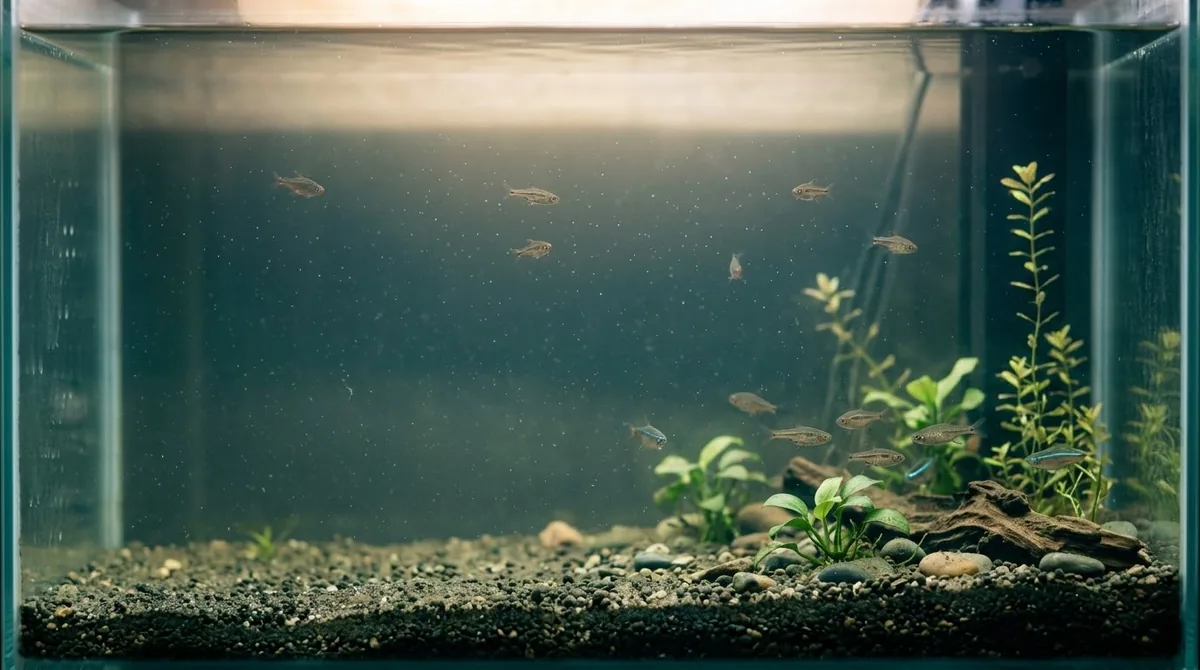
New Tank Syndrome
What is actually happening — and why waiting is the right answer.
You set up a new tank. The water turned cloudy. The fish looked stressed. You tested, changed, added something — and it kept happening.
You did not do anything wrong. What you were watching is one of the most misunderstood phases in the hobby — and almost every keeper goes through it.
This guide walks through what is actually happening, why the instinct to act often makes it worse, and what you can do instead.
A phase,
not a mistake.
Almost every keeper goes through this. The water turns cloudy, the fish seem off, and adjustments do not immediately help. After repeated tweaks, it can feel like you are causing the issue yourself.
What you are seeing is the biological startup phase, not system collapse. New tank syndrome appears in nearly every new setup because core bacteria populations are still forming. The system is alive, but not mature yet.
Reduce intervention and focus on consistency. Keep feeding conservative, monitor trends, and avoid drastic resets. The water just isn't ready yet.
This is the early stage of a tank — the period when the ecosystem is preparing its biological foundation. Most of what feels wrong right now is actually the system doing exactly what it's supposed to at this stage: building, not breaking. What it needs is steadiness and enough time for biology to catch up, not intervention.
Something is building
in the water.
Fish can look stressed very quickly in a new tank. Waste and leftover food break down into ammonia. The form that actually harms fish, un-ionised ammonia (NH₃), makes up a bigger share of that reading at a higher pH and warmer temperature — so the same test-kit number carries more risk in a planted, alkaline tank than in a soft, acidic one. That load can rise before the keeper sees obvious test spikes.
Mature tanks process ammonia almost immediately, but new tanks do not yet have that biological capacity. The conversion system is still being built. Until then, ammonia accumulates and fish feel the stress first.
The cloudiness, the stressed fish, the unstable readings — read them as a system trying to begin, not one going wrong.
Treat behaviour as an early signal. Surface breathing, hiding, clamped fins, and colour loss are meaningful cues, not random events. Respond with steady management and small protective actions while the cycle develops.
This is one reason fishless cycling is now widely preferred — using an ammonia source (pure ammonia or decaying food) to grow bacteria before any animals are introduced. Fish-in cycling subjects living animals to prolonged ammonia exposure that causes real physiological stress. If you have already started with fish, frequent small water changes — not large ones — can keep levels manageable while the cycle builds.
Bacteria are
the only answer.
Many products promise fast stability, but the tank still swings. New tank syndrome cannot be solved by a single additive. Keepers often over-correct because they expect instant reversal.
Beneficial bacteria must colonise real surfaces such as filter media, substrate, and decor. This buildup takes weeks and follows a sequence you cannot force. Once established, they process waste continuously and quietly.
Follow the sequence rather than chasing a perfect daily number. Ammonia rises first, nitrite follows, then both decline as colonies mature. If that arc is unfolding, your system is progressing.
The parameters that look like chaos are actually a sequence. Knowing that does not make the waiting easier — but it changes what you are waiting for.
Bacteria do not live
in the water.
Many keepers worry water changes will remove their bacteria and restart the cycle. That fear can lead to skipping needed maintenance. It also shifts attention away from the true biological core.
Bacteria are settlers, not free swimmers. They form living films on sponge, ceramic rings, bio-balls, and substrate over time. The filter remains the most important habitat for colony stability.
Turning off your filter, even briefly, disrupts a cycling tank more than almost any water change would — it cuts the oxygen the colony depends on, not just the circulation.
Keep maintenance gentle and colony-focused. Water changes do not strip biofilm from filter media, but repeated very large changes can slow bacterial metabolism through abrupt chemistry shifts. If possible, seed with mature filter media from an established tank for the fastest practical start.
Do not rinse filter media under the tap — chlorine will kill the biofilm. Use old tank water instead, and only when necessary. Replacing all the media at once removes the entire colony — leaving a portion preserves continuity. If you are ever upgrading equipment or moving tanks, the filter is the most important thing to carry across.
Not all cycles
take the same time.
Two similar tanks can cycle at very different speeds. That difference often makes keepers think one setup is “wrong.” In reality, timeline variation is normal.
Temperature, available surface area, and colony seeding all change bacterial speed. Cooler water slows Nitrospira activity, while better media area and mature seeding accelerate establishment. Lighting can also influence stability indirectly through algae pressure.
Keep temperature in a supportive range, avoid aggressive media cleaning, and seed from mature media when available. Treat bottled bacteria as a boost, not a bypass. Keep early lighting moderate so algae does not add avoidable instability.
Knowing these variables is not about optimising the cycle like a production process. It is about understanding why your tank and someone else's might behave differently — even when you are doing all the same things. A cold room, an old filter, no seeding. None of that means something is wrong. It just means slower. And slower is fine.
Why doing more
often makes it worse.
When fish look stressed, most keepers intervene repeatedly. That response is caring, but frequent fixes can destabilise a cycling tank. The timeline often stretches because the system cannot settle.
The interventions that slow cycling are usually ordinary and repeatable.
Overfeeding raises ammonia load faster than early colonies can process. Routine ammonia binders can mask numbers while starving bacterial growth. Replacing media removes active colony surface. Adding many fish early overwhelms capacity, and frequent large water changes can repeatedly disrupt chemistry.
Keep interventions minimal and intentional. Feed lightly, preserve filter media, stock slowly, and reserve larger water changes for truly unsafe readings. Let the system build capacity between actions.
This isn't about doing the wrong thing. It's about doing the right thing too often, in a system that needs time more than it needs help.
This is a case where care itself becomes the obstacle. Most of what happens during cycling falls into one category: things that need to be witnessed, not fixed. The difficulty is learning to tell the difference.
In a cycling tank, the biological arc has its own timeline. Techniques that are right in principle — water changes, ammonia dosing, filter management — become counterproductive when applied at the wrong moment. The cycling tank doesn't need more intervention. It needs consistent, low-disturbance conditions that allow the bacterial colony to build at its own pace. Recognising what time a response requires is often the most skilled thing a keeper can do.
The tank finds
its own rhythm.
Early on, it can feel like the tank will never settle. Progress is gradual and easy to miss day to day. That uncertainty makes many keepers doubt the process.
Colony function usually becomes steady after several weeks, though no fixed week-four-to-week-eight timetable holds for every tank — inoculation, temperature, pH, alkalinity, oxygen, and how much ammonia the colony is being asked to process all shift the timing. Ammonia stays near zero, nitrite fades, and fish behaviour normalises once the system gets there. The system gains resilience and can recover from small disturbances.
Transition from emergency mode to rhythm care. Keep routine maintenance, avoid major disruptions, and build slow consistency. You are not aiming for perfection, just a living system that can self-correct.
Watching fish struggle during cycling produces a specific kind of distress — the sense that you must be doing something wrong, even while following every piece of advice you could find. That deserves acknowledgment. What it doesn't track is your competence as a keeper: every tank passes through this biological phase, regardless of who's tending it. Learning to sit with observation instead of reaching to intervene is one of the harder skills in this hobby, and this phase is usually where keepers first practice it.
New tank syndrome ends up being the hobby's first real lesson, not an obstacle to it — the difference between a signal that needs a response and one that simply needs room to resolve on its own. Tank age is a contextual clue about likely colony maturity here, not proof of it; False Maturity covers what that gap can look like once a tank has moved past this early phase.
ARA calls this ecological forgiveness — the capacity of a living system to absorb small imbalances and return to coherence without keeper intervention. Bacteria is only part of what a new tank builds during the Early Phase; the forgiveness that protects everything you add later is the rest.
If you want to see how this unfolds in practice — the ammonia rising, the bacteria arriving, both parameters falling — the simulator on the reading page lets you move through it yourself.
Next best action: Open the Tank Cycle Simulator and run one fishless cycle until Stable ✓ appears. Focus on ammonia/nitrite trends for 3 consecutive days, not a single reading.
Open simulator →- Hovanec, T. A., & DeLong, E. F. (1996). Comparative analysis of nitrifying bacteria associated with freshwater and marine aquaria. Applied and Environmental Microbiology, 62(8), 2888–2896.
- Hovanec, T. A., Taylor, L. T., Blakis, A., & DeLong, E. F. (1998). Nitrospira-like bacteria associated with nitrite oxidation in freshwater aquaria. Applied and Environmental Microbiology, 64(1), 258–264.
- Fowler, S. J., et al. (2024). Comammox Nitrospira among dominant ammonia oxidizers within aquarium biofilter microbial communities. Applied and Environmental Microbiology, 90, e00104-24.
- United States Environmental Protection Agency. (2013). Aquatic Life Ambient Water Quality Criteria for Ammonia — Freshwater.
- Keene, J. L., Noakes, D. L. G., Moccia, R. D., & Soto, C. G. (1999). The acute and chronic toxicity of un-ionized ammonia to rainbow trout. Aquaculture, 180(1–2), 1–15.