The Fish That Sell the Tank
A lone schooling fish in a product photo isn't a stocking choice. It's a colour choice.
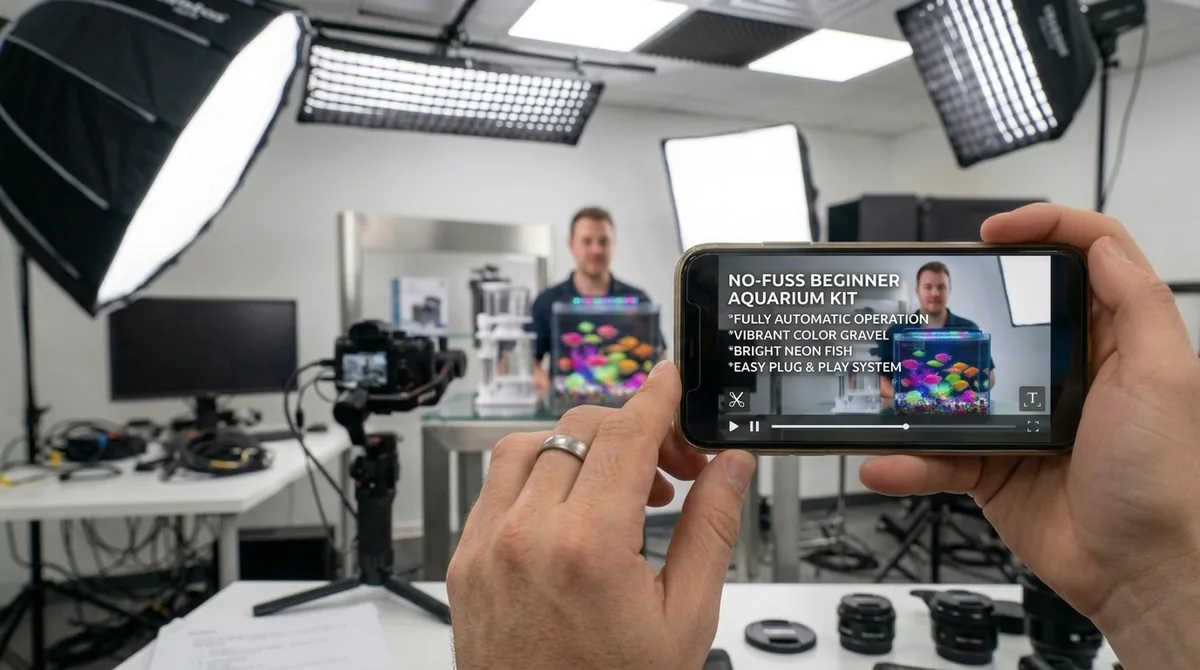
A "smart" nano aquarium ad shows an auto feeder, a built-in filter, colour-changing lights, bare or brightly coloured gravel — and a small handful of fish, one of this, one of that, spaced out for contrast. A single neon tetra. A single guppy. Nobody stocked that tank. Somebody styled it.
This one names that pattern directly, why it specifically targets two real weak points in how people enter this hobby, and what an aligned response actually looks like — for the industry that keeps doing it, and for the keeper deciding whether to trust the next ad that looks just like it.
Livestock, staged as a colour palette
A neon tetra is a shoaling fish. Kept alone, it isn't a smaller version of the fish shown in a group. It's a stressed fish, with no shoal to orient to and no cover of numbers to feel safe in. A guppy dropped in beside it for contrast is a second animal with its own separate needs, not a matching accessory. Whoever composed that product photo made a series of small, specific choices: this fish here for that flash of colour, that one there to balance the frame. Each choice traded a known animal welfare cost for a better-looking image.
The same choice shows up at a larger scale too: a tank filled edge to edge with GloFish — tetras, barbs, danios. Each is a different species engineered for a different fluorescent colour. They're stocked purely to complete a gradient, not because those species share water chemistry, temperament, or activity needs. A full tank can look considered on camera while being exactly the same prop as a single lonely fish. It's just multiplied until the frame reads as abundance instead of colour chosen for its own sake.
Call that what it is: livestock used as a prop for selling hardware, not stocked as a community anyone actually planned to keep. The bare or decoratively coloured substrate underneath, with no real plant or sightline consideration, confirms it. This is a set built for one photograph, not a home built for a lifespan.
Not every person behind that shoot made this choice with malicious intent. A lot of product photography like this follows an industry convention nobody involved has stopped to question. It's one tank, one of everything colourful, styled the way a furniture catalogue styles a room. That distinction matters for how avoidable the outcome should have been. It changes nothing about the outcome itself.
An ad that only works on someone who doesn't know better
Two things make this hobby specifically easy to sell this way. Most people choose their first tank the way they'd choose a piece of furniture. They go by how a finished, styled photo makes a corner of a room look, not by researched compatibility between species. And most first-time buyers genuinely don't yet know that a "neon tetra" needs a group, or that a tank needs weeks to mature before it can safely hold fish. They don't yet know, either, that an auto feeder handles exactly one task out of many a tank actually needs done. Neither of these is a moral failing in a beginner. They're just where everyone starts.
Both vulnerabilities reach their sharpest point when the ad is aimed, even indirectly, at a child. Bright, saturated colour and playful design are exactly what draws a child's attention before any capacity to evaluate long-term care exists. And the decision that follows isn't really made by the person captivated by it. A child pointing at a tank in a shop window or a video becomes the pressure behind a purchase. A parent, not the child, will have to justify, afford, and maintain it. The aesthetics-first pull and the knowledge gap end up operating on two different people at once. The appeal lands on someone with no capacity to weigh it, and the responsibility lands on someone who was never the one being persuaded.
The specific problem is that the ad's entire persuasive power runs on that gap staying open. "Smart," "automatic," and "no fuss" only sound like a solved problem to someone who doesn't yet know what a tank actually requires. To someone who does, that language reads as a warning, not a feature list. An ad that works exactly once — before a buyer learns better, and never again after — isn't selling convenience. It's selling the gap itself, timed to close the sale before it can close on its own.
That's what separates this from ordinary optimistic marketing. Most product marketing exaggerates a real benefit. This specific pattern needs the buyer's unfamiliarity to remain true for the pitch to work at all. That puts genuine incentive on the other side of buyer education, not just indifference to it.
"An ad that only works on someone who doesn't yet know better isn't selling convenience. It's selling the gap itself, before it can close."
False capacity, installed before the tank exists
Capacity before Ambition usually describes a keeper's own restraint — knowing what a setup actually asks of you before adding more to it. This pattern names a version of the same failure that happens earlier, and to someone else's advantage. A buyer's sense of what the tank will require gets shaped by the ad before they've done a single water change — and it gets shaped wrong on purpose. "No water changes needed" and "fully automated" aren't small exaggerations. They're a false capacity reading, installed at the exact moment a real one should have started forming.
This connects directly to why so many new keepers stock a tank the same day it arrives, and why the fish start dying in week two. A tank photographed as finished on day one teaches, wordlessly, that a tank simply arrives finished. There's no mention of cycling, no sense that the water itself needs weeks to become safe before anything is added to it. The ad isn't just wrong about maintenance. It hides the entire waiting period from view.
A real capacity decision eventually arrives: a water change running late, algae spreading, a fish showing the first signs of stress. By then, a keeper who trusted that ad often doesn't recognise it as a decision at all. They were told the system already handled it. That isn't a hypothetical harm traced back to a photo. It's the same mechanism behind nearly every panicked "why do my fish keep dying" post from someone in their first month. It's just one step further upstream, at the moment of purchase.
The same reading skill, aimed one step earlier
None of this means every nano tank is a bad idea, or that every automated feature deserves suspicion. Plenty of experienced keepers use an auto feeder or a built-in filter well, for a trip away or a genuinely low-bioload setup they already understand. What's being named here is a narrower, specific choice: staging an ad around the fantasy of absence, aimed at someone who doesn't yet know what presence actually requires. That choice belongs to whoever built the ad. It doesn't belong to the hobby, and it isn't the fault of the beginner who trusted it.
A few tells are worth reading for before trusting the next one that looks like it. A schooling species — tetra, rasbora, danio — pictured as a single fish is one. So is a tank filled with different species chosen for a colour gradient rather than shared care needs. Watch too for language promising no water changes or full automation with no mention of cycling at all. Softer wording like "self-cleaning" implies the same absence of maintenance without saying so as plainly. And watch for a tank shown fully stocked in what's clearly its first appearance, with nothing said about how long it took to get there. Or watch for a bioload implied by what an auto feeder can dispense rather than by what the animals actually need.
Noticing these doesn't take expertise — just a few specific questions asked before checkout instead of after the first fish shows signs of trouble. Reading an ad this way is the same skill the rest of this site tries to build for reading a tank itself. It's the difference between what's actually being shown and what's only being implied.