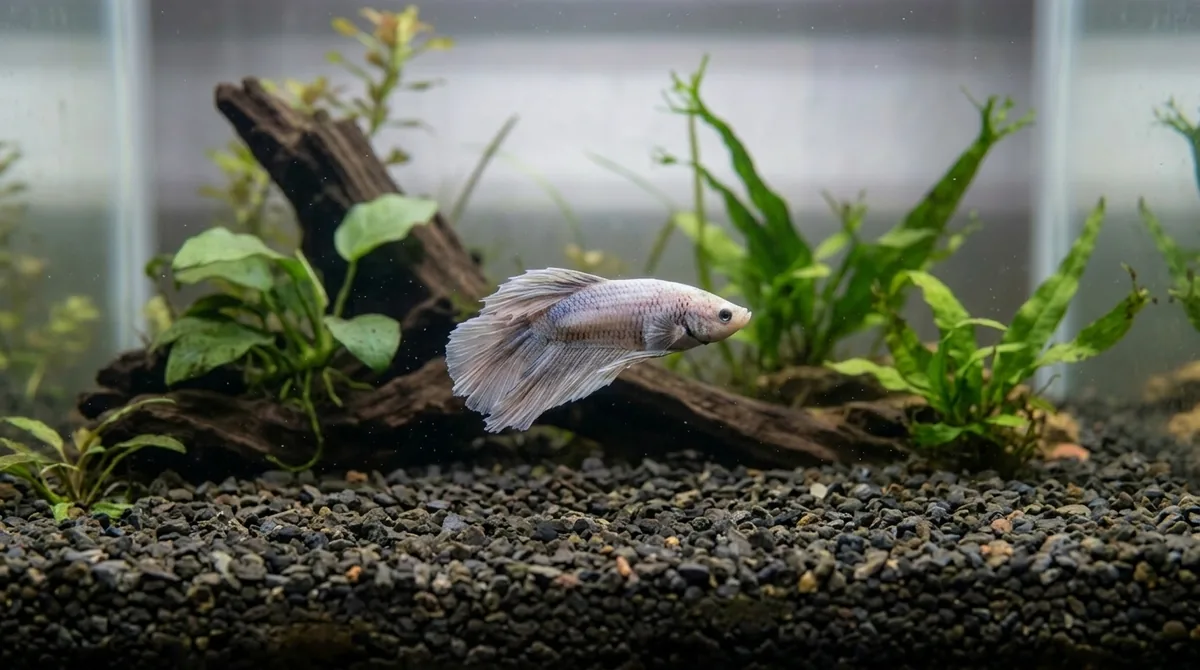
Sudden Colour
Loss in Fish
Fading and darkening speak before behaviour does.
A fish that suddenly looks noticeably paler, or unusually dark and dull, hasn't changed its behaviour yet — it's still eating, still swimming normally. Colour is often the very first thing to shift, and the easiest thing to explain away.
This guide explains why colour changes happen at all, how to tell a brief fright response from something that needs attention, and why chasing colour directly is rarely the right fix.
Paler, or darker —
both are the same kind of signal.
Colour change in fish runs in two directions, and both matter equally. Fading is a fish looking washed out, paler, or less vivid than its usual colouring. Darkening is the opposite: a fish that looks unusually dull, dark, or blotchy compared to how it normally appears. Neither is more or less serious than the other — they're two expressions of the same underlying mechanism.
The reason colour is worth watching closely is that it often shifts before anything else does. A fish can look off in colour for a day or two while still eating normally and swimming with its usual energy. It can show no other visible symptom at all. By the time hiding or appetite loss show up, colour has frequently already been signalling for a while.
Before reading too much into any single observation, it's worth knowing the fish's baseline first. Some species naturally darken at night or during rest, and juveniles often haven't developed adult colouring yet. Breeding condition can also intensify or shift colour temporarily, in ways that have nothing to do with stress.
A fish's normal day-to-day colour range is worth knowing before treating any single change as meaningful. Some cichlids and killifish darken visibly at night on a completely predictable schedule — that's rhythm, not distress.
Colour isn't voluntary.
It's a readout.
Fish colour comes from pigment cells in the skin that expand or contract in response to nervous system and hormonal signals. These are the same physiological pathways the body uses to respond to stress. A fish doesn't choose to look pale any more than a person chooses to blush; the colour change is downstream of something the body is already doing.
A brief fright. A sudden disturbance — a hand near the tank, a loud noise, a predator-shaped shadow — can trigger a rapid, temporary colour shift. This is sometimes called a fright response, or stress bars. This resolves within minutes to a couple of hours once the fish settles, with no lasting effect.
Sustained water quality or environmental stress. Ongoing poor water conditions, an unstable temperature, or persistent tankmate pressure can produce a colour change that doesn't resolve on its own, because the underlying trigger hasn't gone anywhere.
Illness. Colour dulling is one of the most common general signs that a fish is unwell, though it rarely appears alone. It's usually paired with reduced activity or appetite once the underlying issue progresses.
Diet. Some pigments, particularly the carotenoids behind orange and red colouring, depend directly on diet. A gradual fade over weeks, rather than a sudden change, more often points here than to acute stress.
"A fish's colour is closer to a heart-rate monitor than a mood ring. It's telling you what the nervous system is already doing, not making a choice about how to look."
Time and company
matter more than the colour itself.
The most useful question with any colour change is how long it lasts. A shift that appears right after an obvious startling event and fades within an hour or two is almost certainly a fright response. No action is needed beyond letting the fish settle. A shift that persists for a full day or longer, especially with no obvious trigger, points toward something ongoing rather than momentary.
Colour on its own rarely tells the full story, so check what's happening alongside it. Is the fish still eating normally? Still swimming with its usual energy and using the whole tank? Are the fins intact and unclamped? A colour change paired with any of these other shifts is a stronger signal than colour alone. It points more clearly toward water quality, illness, or aggression as the driver.
Test ammonia, nitrite, nitrate, and temperature regardless of what else you observe. Water quality is one of the most common drivers of a sustained colour shift, and it's also the fastest thing to rule in or out.
Colour-enhancing foods and additives treat the readout, not the cause. If the underlying stressor is still present, added colour compounds won't restore normal pigmentation. If it's been resolved instead, the fish's own colour typically recovers within a week or two without any special product.
Fix what the colour
is actually pointing at.
If the change was brief and tied to an obvious startle, the aligned response is simply to leave the fish alone and let it settle. Nothing about the situation calls for intervention.
If the colour change is sustained and paired with other shifts in behaviour, address whatever those other signals point to. Correct water parameters if they're off, separate an aggressive tankmate, or investigate illness if there are visible physical symptoms alongside the colour change. The colour itself resolves as a side effect of fixing the actual cause, not as a target in its own right.
If the fade has been gradual over weeks with no other symptoms at all, and the fish is a species whose colour is diet-dependent, reviewing feeding variety is worth doing. This is the slower, less urgent end of the spectrum compared to a sudden shift.
"The colour was never the problem. It was the first place the problem happened to show up."
- Fujii, R. (2000). The regulation of motile activity in fish chromatophores. Pigment Cell Research, 13(5), 300–319.
- Goda, M., McGuigan, N., Horsch, A., et al. (2012). A fluorescent chromatophore changes the level of fluorescence in a reef fish. Proceedings of the Royal Society B: Biological Sciences, 279(1740), 3219–3226.
- Bagnara, J. T., & Hadley, M. E. (1973). Chromatophores and Color Change: The Comparative Physiology of Animal Pigmentation. Prentice-Hall.