Why Your Snails Are
Suddenly Everywhere
A population boom is a feeding signal, not a pest problem.
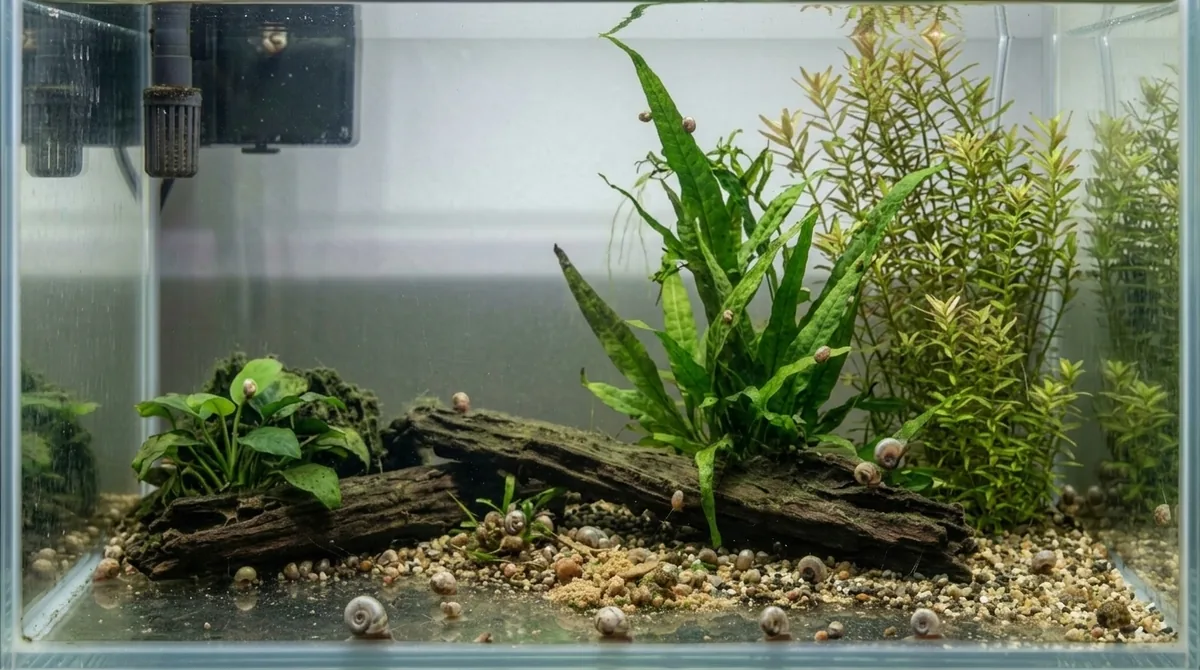
A tank that had maybe one or two snails quietly living in it for months suddenly seems to have them on every surface — the glass, the substrate, the underside of every leaf. Nothing about the snails themselves changed. Something else did.
This guide explains what actually drives a snail population boom, why picking them off by hand rarely solves it, and what brings the numbers back down for good.
The snails didn't arrive.
They were already there.
Small pest snails — ramshorn, pond, and bladder snails among the most common — almost always enter a tank as hitchhikers. They arrive tucked into new plants, décor, or substrate as tiny juveniles or eggs, invisible to the eye at the time. A tank can carry a small, low-level population for months without a keeper ever noticing them.
What changes isn't that snails showed up. It's that a population that was already there suddenly became visible — covering the glass, dotting the substrate, clustering on leaves. It can feel like the space of a single week.
That shift from invisible to unmissable is the actual signal worth reading. The snails aren't the event. The change in their numbers is.
A boom in numbers, not the mere presence of snails, is what's informative here. A tank with a handful of snails quietly grazing algae is a completely different situation from one where the population has visibly exploded in the last week or two.
Snails reproduce
to match the food supply.
These snails are hermaphroditic and reproduce continuously in small numbers under ordinary conditions — but their reproductive rate scales directly with how much food is available. Give the population a sudden surplus of something to eat, and numbers can multiply dramatically within weeks.
The surplus is almost always leftover food. Overfeeding is the most common cause. Feeding more than the fish clear in a few minutes, or a recent increase in feeding — a new fish added, a switch to a richer food, more frequent feeding — floods the tank with exactly the organic material a snail population needs to expand. Decaying plant matter from dying leaves or recently added plants adds to the same supply.
None of this is really about the snails at all. A visible boom in their numbers is a bioload signal wearing a shell. It's the same underlying pattern that shows up as rising nitrate or cloudy water, just read through a different indicator.
"Snails don't multiply because a tank has a snail problem. They multiply because a tank has more food in it than anything else is eating."
Picking them off
treats the wrong number.
Manually removing visible snails is a common first instinct, and it does very little on its own. The food surplus that let the population boom in the first place is still there. The ones left behind — plus whatever eggs are already laid — simply repopulate to fill the same space within a couple of weeks.
Before doing anything else, look at feeding directly. Is food disappearing within a few minutes, or is some left drifting to the substrate or sitting on plant leaves? Has feeding amount or frequency increased recently — a new fish, a richer food, an extra feeding added to the routine? Has anything organic been added recently, like new plants or décor that might be decaying?
This is worth checking even in a tank that's otherwise seemed fine. A snail boom often shows up before nitrate or water clarity change enough to notice, making it one of the earlier readable signs of a feeding surplus building up.
At the next feeding, watch the clock. If food is still visible on the substrate or drifting in the water column after five minutes, that's more going in than the tank's other inhabitants are actually using. That's true regardless of what the snail population is doing about it.
Match feeding to appetite.
The population follows.
The aligned response is to bring feeding back in line with what's actually being eaten: smaller portions, cleared within a couple of minutes. Remove any obvious leftovers promptly, rather than leaving them to break down in the tank. This addresses the actual surplus rather than the snails standing in for it.
The population doesn't need to be eliminated to come back down — it needs the food surplus removed. Once feeding is corrected, snail numbers typically settle back to a low, unnoticeable level within a few weeks as reproduction slows to match the smaller supply. No chemical snail treatment is needed for this — and reaching for one isn't a bad instinct; a sudden population boom looks like something to fight, not a feeding pattern to fix. Those products just add their own chemical load to the water, while doing nothing about the feeding pattern that caused the boom.
If the visible numbers are genuinely bothersome in the meantime, manual removal or a predatory species like an assassin snail can speed up the visible cleanup. Neither replaces fixing the feeding — both address the symptom, while the underlying fix does the actual work.
"The snails were never the thing to solve. The feeding was — the snails were just the easiest part of it to see."