How to Build an Aquarium
Maintenance Routine
That Actually Fits Your Life
The routine that works is the one you can sustain. Not the one that looks good on paper.
Most aquarium maintenance schedules are built for an ideal keeper — one with the same amount of time every week, reliably, for years. That keeper is rare.
This guide helps you build a routine for the keeper you actually are, using your real keeper rhythm rather than the one you intend to have.
The weekly checklist
was not written for your life.
Most aquarium guides include a maintenance schedule. It typically looks something like this: water change every week, gravel vacuuming every other week, filter rinse monthly, glass cleaning as needed. It is technically sound advice — for a keeper who has the same amount of time every week, reliably, for years.
That keeper is rare.
For most people, the rhythm of life — work, travel, illness, family demands, irregular energy — means that "weekly" is an aspiration, not a reliable commitment. The tank gets what is available. Some weeks, that is more than scheduled. Some weeks, it is nothing.
The problem is not the gap. The problem is that most maintenance advice was designed without accounting for the gap. When you follow a weekly schedule for three weeks and then miss two in a row, the advice gives you no framework for what to do next — how large to make the catch-up change, how to read whether the system absorbed the gap, what to do differently next time.
A maintenance routine built on the keeper's actual keeper rhythm is more useful than one built on an ideal. It is also more stable for the tank — because a modest consistent pattern is almost always healthier than intensive irregular intervention.
A tank that receives 20% water changes every ten days is more stable than one that receives 40% changes every three weeks when the keeper finds time. Coherent continuity matters more than volume.
Small, regular actions done with coherent continuity produce more stable ecosystems than periodic large efforts. This isn't just true for tanks. It's true for most living systems.
You already have a rhythm.
The question is whether your tank fits it.
The four ARA keeper rhythm types are not personality categories. They are honest descriptions of how people actually engage with their tanks over time. Most keepers recognise themselves in one of them fairly quickly — and recognising the pattern is the first step toward designing a routine around it.
Episodic care. High engagement in bursts, with longer gaps between. You are highly attentive when something needs attention or when you have the time and energy. Then life takes over and the tank runs itself for a while. Common pattern: intensive sessions of water changes, glass cleaning, and observation followed by two to three week gaps.
Irregular care. Maintenance happens, but not on a fixed schedule. You know the tank needs a water change — and you do it when you can, not when the calendar says to. The intent is consistent; the timing is not.
Incremental care. Small, frequent actions. You enjoy spending time at the tank and do a little each day or every few days rather than larger sessions less often. You are more likely to top off evaporated water, spot-clean the glass, and check the temperature regularly than to do a monthly deep clean.
Low-engagement care. The tank runs mostly alone. You provide water changes, feeding, and basic observation, but intensive maintenance is rare. This is not neglect — it is a realistic assessment of what the hobby can ask of a particular life.
None of these are wrong. Each has a corresponding tank design that supports it. The misalignment between keeper rhythm and tank design is what produces the drift most keepers experience — not any individual missed session.
Three questions worth sitting with honestly:
When did you last do a water change? When did you do the one before that? What is the actual interval, not the intended one?
Have you ever done a catch-up maintenance session after a longer gap than planned — and if so, how often does that happen? Is it occasional, or is it the pattern?
Do you find small regular actions easier than larger periodic ones, or the reverse? Which feels more natural when you have the energy to engage?
Match the routine to your rhythm.
Then build in the buffer.
Each keeper rhythm calls for a different approach. The goal in every case is the same: Capacity before Ambition. A routine you can actually sustain, designed around the gaps you will realistically have, is more valuable than the theoretically optimal schedule.
For episodic keepers. The immediate goal is designing a tank that can absorb your gaps without crisis: a lower bioload — fewer fish, smaller fish — to reduce waste accumulation between sessions; a larger tank relative to fish count for water volume and buffering; strong biological filtration, established and never cleaned aggressively. When you do have a session: a 20–25% water change, gravel vacuum, glass clean, and a parameter check. After a long gap, test the water before doing a large change — a sudden large water change in a tank that has been stable at elevated nitrate can stress fish more than a gradual reduction. This is where the work starts. The direction ARA names is toward closing those gaps — not immediately, not by force, but incrementally, as capacity allows.
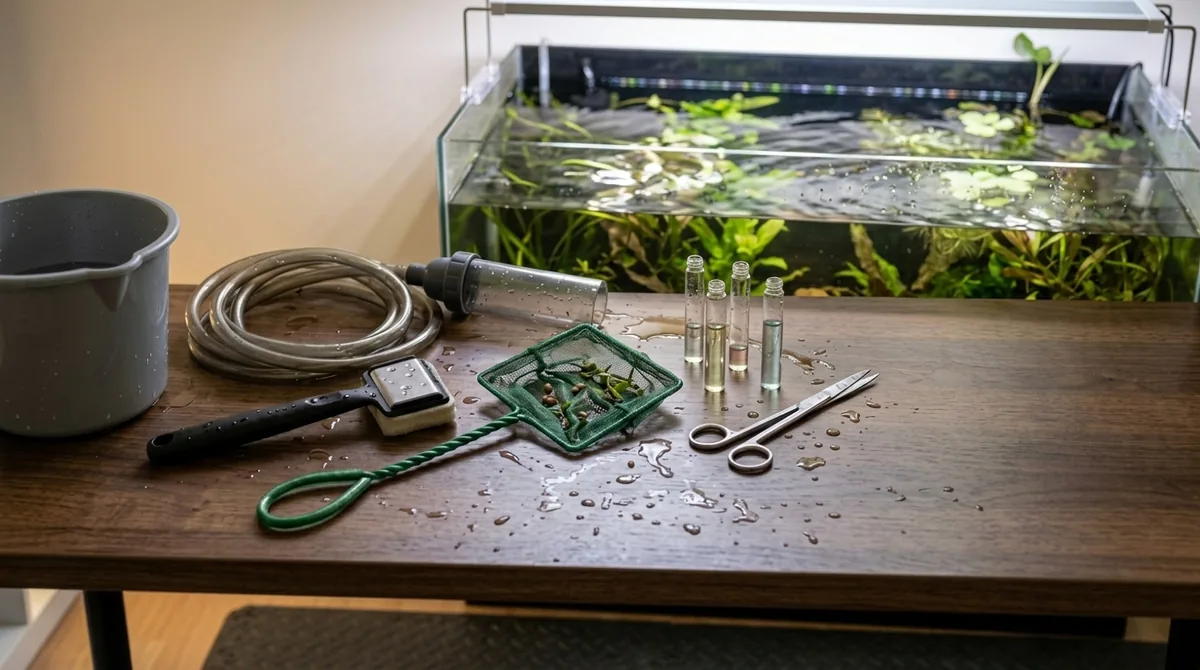
For irregular keepers. The goal is removing friction from the maintenance so it happens more easily when you do have time. Keep the water change equipment accessible and simple — a bucket and siphon that are always out, not stored away. Set a minimum that is achievable even on low-energy days: a 15% change with no vacuuming, just the water. The full routine is for when you have more time; the minimum is for when you do not. The minimum done regularly is more valuable than the full routine done occasionally.
For incremental keepers. The goal is structuring the small actions so they add up to a complete maintenance cycle over time. A practical pattern: check temperature and observe fish for five minutes on two days per week; top off evaporated water with dechlorinated water mid-week; do a 20% water change with a light gravel vacuum of accessible areas once a week; rinse filter media in tank water (never tap water) once a month. Each individual action is small. Together they constitute a complete care cycle.
For low-engagement keepers. The goal is automation and simplification wherever possible. A quality programmable heater eliminates temperature checks. A timer for lights eliminates photoperiod management. A canister filter over a hang-on often requires less frequent maintenance. Choosing hardier, less demanding species reduces the consequences of gaps. Test strips rather than liquid kits lower the friction of occasional water checks. The tank is designed to need less from you — and it functions well within that design.
The routine that gets done is more valuable than the routine that is theoretically optimal. A 15% water change every ten days beats a 40% change whenever you can manage it.
A programmable heater, an auto-doser, a monitoring app — these can genuinely stretch what a busy keeper can sustain, but only for someone who understands what the equipment is actually doing. Set up and forgotten, the same automation becomes a blind spot: when it fails quietly or smooths over a warning sign, it stands between you and the exact information your routine depends on.
Start honest.
Build from there.
The most reliable way to build a maintenance routine is to start with what you have actually been doing — not what you plan to do. If your honest interval is ten days, make ten days your baseline. If your honest interval is three weeks, make three weeks your baseline with a tank designed to hold that gap without stress.
From that honest baseline, small improvements are possible: reducing the interval slightly, reducing the effort per session by making equipment more accessible, adding one incremental action per week. But the foundation is honesty, not aspiration. A routine built on an overestimated version of your available time will produce drift — the slow, structural misalignment between what the tank needs and what it receives.
What happens when you miss the interval: most well-established tanks with appropriate fish loads can absorb a gap without crisis. The Water Rhythm drifts slightly, and the Livestock Rhythm may show subtle signals before any test kit does. When you return to maintenance, do a water test first, then a modest change rather than a large catch-up, then observe. The system has capacity to absorb gaps — that is what Ecological Forgiveness means in practice. The goal on return is not to compensate for the gap in one session. It is to re-establish the pattern.
The gap between the routine you intend to have and the one you actually manage is one of the most common sources of keeper guilt in this hobby. It's worth naming: falling behind on water changes doesn't say anything about your character. It says the tank's demands and your actual available rhythm haven't been matched yet. When that gap creates guilt, keepers often swing between over-compensating (large emergency changes) and avoidance — both of which produce more instability than a modest, imperfect routine would. The misalignment between keeper and tank is adjustable. The guilt about it is optional.
The Keeper Readiness Check reflection — seven questions about how you actually engage with things you care for over time — helps identify which pattern describes you most accurately. It is a starting point for matching any tank design to the keeper who will actually care for it.