The Smell From
Your Substrate
A rotten-egg smell during maintenance is the tank telling you something specific.
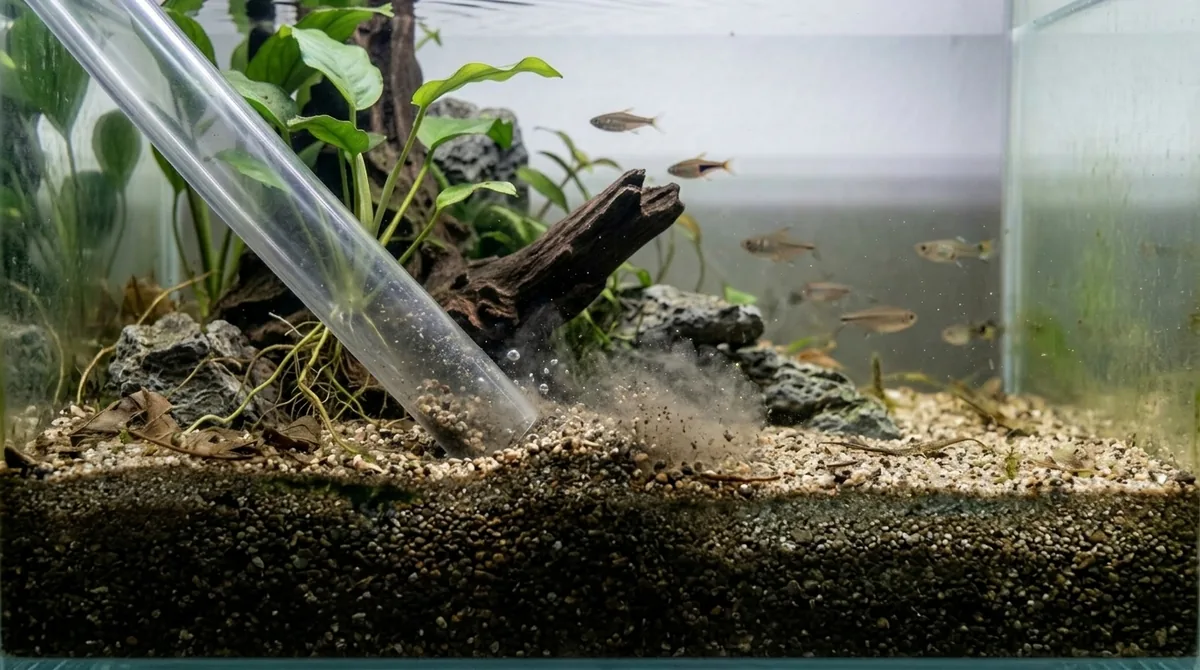
You're vacuuming the gravel, or moving a piece of décor, and a sudden whiff of sulphur — a distinct rotten-egg smell — rises out of the substrate. It's unpleasant, a little alarming, and gone again within seconds.
This guide explains what's actually producing that smell, why it collects harmlessly under the surface most of the time, and the one situation where a big release of it is worth taking seriously.
A smell that only shows up
when you disturb something.
The smell in question is specific, not the general "established tank" smell most aquariums have — a faint, earthy, slightly mineral scent that's normal and constant. This one is different. It's a distinct rotten-egg, sulphurous burst that appears only when the substrate is disturbed — vacuuming a patch of gravel, moving a rock, pushing a plant stem in — and it fades again within moments.
That localised, disturbance-triggered pattern is itself informative. It means whatever is producing the smell isn't spread evenly through the tank; it's concentrated somewhere specific under the surface, sealed away until something physically breaks that seal.
A single brief whiff during routine maintenance is common enough that most experienced keepers barely react to it. What's worth reading more carefully is the strength of it, how widespread it is, and whether it coincides with anything else changing in the tank.
A healthy established tank has a mild, earthy scent that's always there, not something that appears only when you stir the gravel. If what you're smelling is constant rather than disturbance-triggered, that's a different situation from the one this guide covers.
Oxygen never reaches
that pocket.
Deep or compacted substrate can develop pockets where oxygen simply never penetrates. The water above stays oxygenated, but a few centimetres down, in a dense or undisturbed patch, none of that oxygen reaches. A different kind of bacteria thrives specifically in that oxygen-free environment: sulfate-reducing bacteria, which produce hydrogen sulfide gas as a byproduct of their own metabolism.
That gas is what you're smelling. As long as the pocket stays sealed, it accumulates harmlessly beneath the surface. The moment something disturbs it — a gravel vac, a moved decoration, replanting — the seal breaks and the trapped gas releases all at once. That's why the smell appears suddenly and briefly, rather than lingering.
These pockets form most readily in substrate that's deep, fine-grained, or compacted with no flow moving through it. Corners behind décor that never get vacuumed, thick layers of old substrate with years of accumulated detritus, and areas with heavy root systems all create dense, undisturbed zones underneath.
"The smell isn't the substrate going bad. It's a small, sealed pocket where the tank's biology quietly kept working without any oxygen to answer to."
Small and brief
is a different case from big and sudden.
A faint whiff that disappears within a few seconds during ordinary gravel vacuuming is the common, low-stakes version of this signal. It doesn't call for anything beyond continuing to vacuum that area a little more regularly than before. That way, the pocket that produced it doesn't have time to rebuild to the same size.
A strong, widespread smell, dark or blackened patches of substrate, or fish showing sudden distress right after a big disturbance is a different scenario. Hydrogen sulfide is genuinely toxic to fish at higher concentrations. A large buried pocket released all at once — say, during a full substrate overhaul rather than routine spot-vacuuming — can release enough of it to matter.
The distinction that matters is scale: a small pocket disturbed occasionally is self-limiting and mostly harmless. A large pocket that's built up for a long time and gets released all at once is the version worth responding to quickly.
Watch the fish closely for the next hour. Do a partial water change promptly if anything looks off — laboured breathing, erratic swimming, or unusual lethargy right after a large substrate disturbance. Increasing surface agitation temporarily also helps re-oxygenate the water faster.
Small, regular disturbance
prevents the big kind.
The aligned habit is routine. Gravel-vacuum the corners and dead zones that normally get skipped, not just the open, easy-to-reach areas, so pockets never get the chance to grow large before being disturbed. This keeps every release small and brief, which is exactly the low-stakes version of the signal.
Bottom-dwelling, substrate-sifting livestock — corydoras and similar species — and root-feeding plants both help keep substrate lightly turned over on an ongoing basis. That reduces how easily large sealed pockets form in the first place.
If a full substrate disturbance is planned — a rescape, adding new substrate, deep-cleaning an area that's gone untouched for a long time — do it gradually over a couple of sessions rather than all at once. That avoids releasing a large accumulated pocket in one go.
"Reading the small signal regularly is what keeps you from ever having to deal with the big one. A little smell every few weeks is the substrate managing itself. A lot of it all at once is the substrate finally being asked to."