Is Your Setup
Too Demanding?
Some tanks quietly need more than the routine you actually have.
Nobody sits down and decides to build a tank that needs daily attention. It happens one reasonable upgrade at a time — a bit of CO2 here, a sensitive species there — until the setup quietly needs more than the keeper has to give.
This guide explains how that mismatch builds, the choices that raise it fastest, and how to check honestly whether your setup still fits your actual routine.
Nobody chooses a demanding tank
on purpose.
Almost no one sets out to build a setup that needs daily, precise attention. It builds up gradually, one upgrade at a time, each one reasonable on its own. CO2 gets added because the plants will grow better. A striking wild-caught species gets added because it's beautiful.
Each choice makes sense in isolation. None of them feels like a commitment to a harder routine. But the demands stack. A tank that started as a simple, forgiving setup can end up needing daily monitoring, precise dosing, and tight parameter control. There's rarely a single moment where the keeper decided that was the plan.
This is the mirror image of capacity creep. Capacity creep is a keeper's routine quietly drifting down. This is a setup's real requirements quietly drifting up. Either direction opens the same gap between what a tank needs and what it actually gets.
None of these upgrades are wrong by themselves. The issue is never any single piece of equipment or species. It's whether the total, stacked requirement still matches the routine the keeper actually has time for.
A few choices raise the bar
far more than they look.
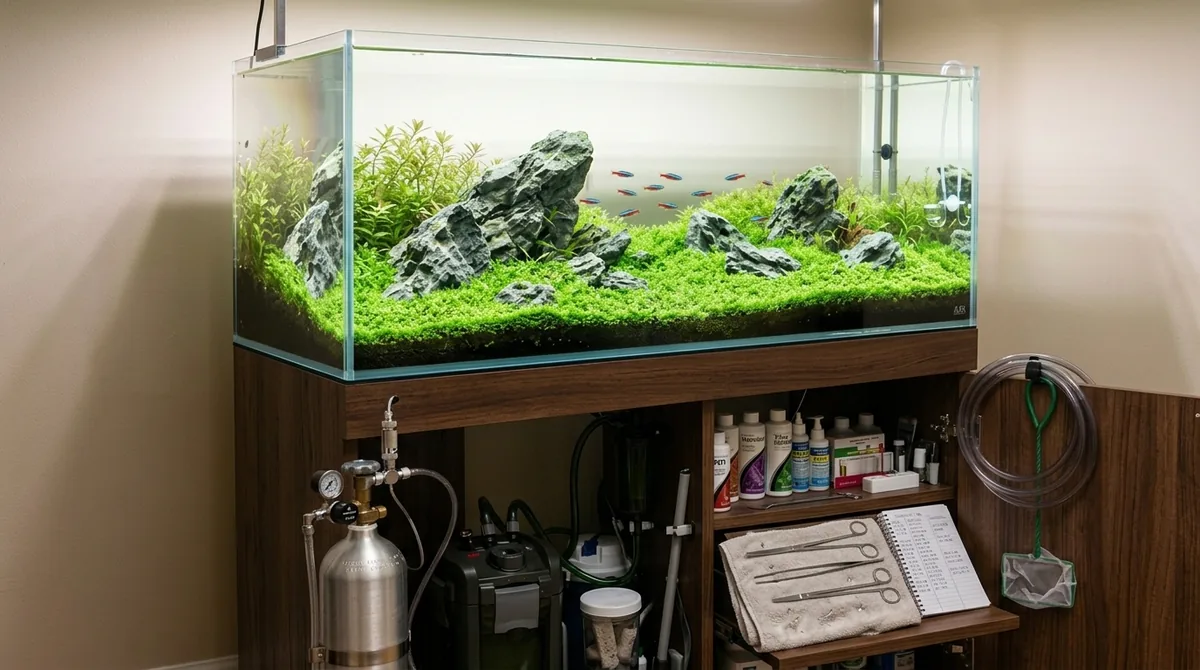
CO2 injection. Beyond the equipment itself, CO2 needs regular monitoring so it never drifts high enough to stress fish overnight, and it usually comes paired with a fertiliser dosing schedule. Skipping either for even a few days can visibly set plant growth back or trigger algae.
Precise dosing routines. Fertiliser schedules dosed multiple times a week, or medication regimens with exact timing, turn maintenance into something that has to happen on specific days, not whenever it's convenient.
Sensitive or wild-caught species. Fish adapted to narrow, stable natural conditions tend to tolerate far less parameter drift than tank-bred community species. A missed water change that a hardy species shrugs off can genuinely stress a species with a narrow comfort range.
High bioload relative to tank size. A heavily stocked tank has less buffer for any delay at all, so the whole setup becomes less forgiving of an inconsistent schedule, even before anything else is added.
"Each of these choices raises what the tank needs from every single week, not just what it needs once. That's what makes them multipliers rather than one-time costs."
A few honest questions,
not a checklist to fail.
Because these choices stack gradually, checking for a mismatch needs a direct question. A vague sense of "I'm managing fine" won't catch it — a few honest questions tend to surface it clearly.
These aren't pass-or-fail. Answering one or two honestly, and not loving the answer, doesn't mean the setup has to change today. It means the mismatch is worth noticing before life gets busier, not after.
If a busy two weeks happened right now — a work crunch, travel, illness — would this tank still be fine when you got back to it? Have you added any piece of equipment or any species specifically for a result, without thinking through who keeps it consistent when you're stretched thin?
Does the maintenance routine feel like a task you schedule around your life, or has your life started scheduling around it? And honestly, does tending this tank still feel like the hobby you started, or does it feel like a second job most weeks?
Scale the setup down,
not the routine up.
When the questions surface a real mismatch, the aligned move is usually to simplify the setup rather than force a harder routine into an already-full life. Removing CO2 and switching to lower-light, low-tech plants keeps a tank attractive without the daily monitoring. Rehoming a species that needs tighter conditions than the routine can reliably provide is a kindness to that fish, not a failure.
This isn't giving up on the hobby. It's matching ambition to actual, current capacity — the same principle behind building a routine that fits your life. Here it's just applied to the setup side of the equation, not the schedule side.
A tank that tolerates an inconsistent week without real consequences is more sustainable, long term, than an impressive one that only survives on a perfect schedule. The second kind looks better in photos right up until the week it doesn't.
"A tank shouldn't need a keeper who never has a hard week. The setup that fits your actual life beats the one that only works when everything goes right."