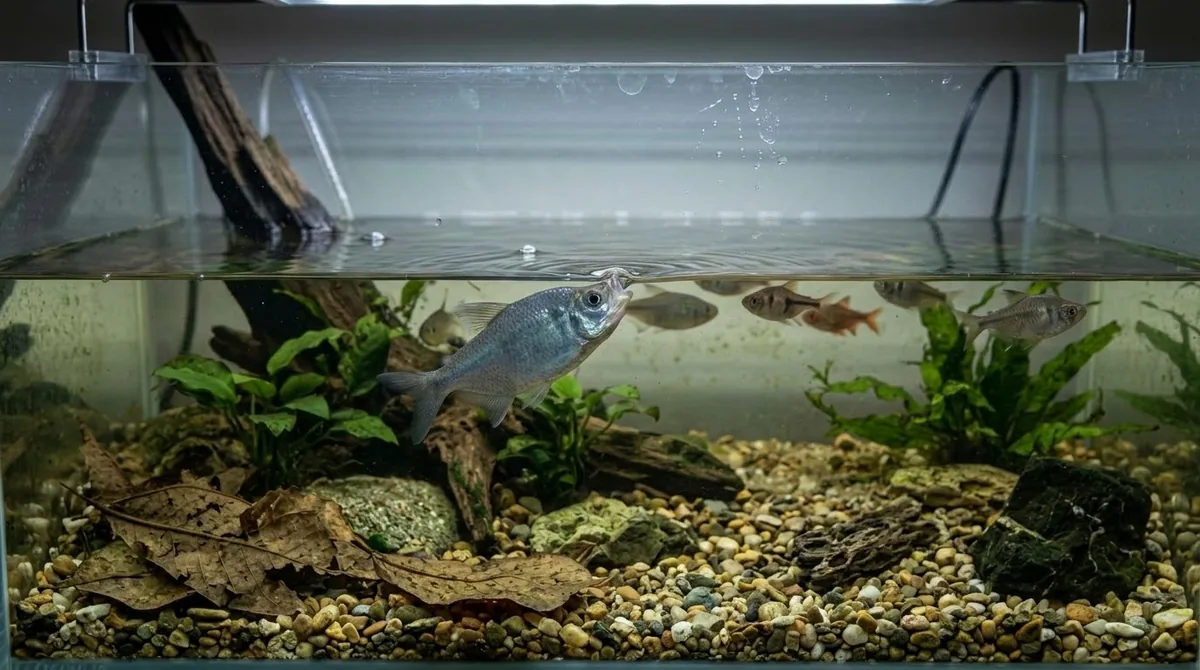
Fish Gasping
at the Surface
The tank is running out of something. The question is what.
You look at your tank and the fish are at the surface, mouths working. Some are hanging just below the waterline, barely moving. Others swim normally but keep returning to the top. It looks urgent, and it often is — but the right response depends entirely on what is causing it.
This guide walks through the most common reasons fish gasp at the surface, how to distinguish between them using what you can observe right now, and what an aligned response looks like for each.
Reading the signal
Fish gasping at the surface is a distress signal — the fish are trying to access more oxygen than the water currently provides, or they are unable to use the oxygen that is there. The key is that several different causes produce the same visible behaviour, and treating the wrong one at best does nothing and at worst accelerates the problem.
The four most common causes are: low dissolved oxygen, high carbon dioxide, ammonia or nitrite poisoning, and gill damage (from disease or parasites). Of these, low dissolved oxygen and CO2 toxicity are the most common in home aquariums. Ammonia poisoning usually accompanies other visible symptoms and test kit confirmation. Gill damage is typically accompanied by other disease signs — flashing, white patches, or mucus on the body.
Low dissolved oxygen is most likely when: all species in the tank are gasping simultaneously; the tank is warm (warmer water holds less oxygen); surface agitation is minimal; the filter flow has slowed; it happened overnight or in the early morning when plant photosynthesis stops and respiration continues. The first reading is also the first response: increase surface agitation — move the filter outlet to break the surface, add an airstone, or turn on a powerhead near the surface. If the fish return to normal depth within 30 minutes, oxygen was the cause.
High CO2 is most likely when: it happened during daylight hours in a heavily planted tank with CO2 injection; plants appear healthy; pH tested low; turning off the CO2 injection and increasing surface agitation brings improvement within an hour. CO2 injected at night or in excess acidifies the water and competes with oxygen at the gill surface even when oxygen levels are technically adequate.
Ammonia/nitrite poisoning — test immediately. If ammonia is above 1 ppm or nitrite is detectable, this is the cause. Fish will also show red or inflamed gills, rapid breathing even at rest, and may dart or flash. Response: 25–30% water change immediately.
"The surface is the fish's last resort. By the time gasping is visible, the tank has been signalling for some time in ways that didn't yet reach the threshold of visibility."
Oxygen, temperature, and surface agitation
Dissolved oxygen enters aquarium water almost entirely through surface agitation — the movement of water at the air-water interface. A still surface in a warm tank is an oxygen-limited tank waiting for the right conditions to express it.
Several factors combine to reduce dissolved oxygen simultaneously: summer room temperature rise warms the tank water (oxygen solubility decreases as temperature increases); algae blooms consume oxygen overnight as respiration continues without photosynthesis; bioload increases (more fish, larger fish, more decomposing organic matter all consume oxygen); filter flow slows due to partial blockage.
Each factor individually may not produce gasping. Combined, they can drop dissolved oxygen below the tolerance threshold for all species simultaneously — which is why gasping events often appear sudden and confusing when the individual factors have been present for weeks. The aligned response begins before gasping: keep surface movement active, maintain a clean filter, avoid overstocking relative to the season (a tank that was fine in winter may need reduced bioload in summer), and watch for slowing filter flow as an early indicator.
Dissolved oxygen is part of the ongoing physical conditions the tank maintains. An oxygen depletion event is a reading: conditions drifted beyond what the fish could tolerate. The event wasn't sudden. The drift was.
Aligned response and prevention
The immediate response to any gasping event: first, increase surface agitation now — move the filter outlet, add an airstone, create water movement. This buys time regardless of the cause. Second, test ammonia and nitrite — if elevated, do a 25–30% water change with dechlorinated water that is temperature-matched. Third, if CO2 is injected, reduce or pause injection and increase surface agitation. Fourth, observe for 30–60 minutes while maintaining surface movement.
If the fish return to normal depth and behaviour, the cause was oxygen-related and you have time to investigate the contributing factors. If they do not improve, or if you observe gill redness, darting, or mucus, suspect disease and consult a specialist.
Prevention is about reading the system before it reaches the gasping threshold. Check filter flow weekly — a partially blocked filter is the most common silent contributor. Monitor tank temperature during warm seasons. Do not allow surface agitation to slow without addressing it. Watch for signs of CO2 excess (pH crash overnight in injected tanks, yellowing water, fish near the surface specifically in the morning before lights on).
The gasping event is the end of a sequence. The aligned keeper reads the earlier steps: slowing flow, warming water, accumulating organic load — and adjusts before the sequence completes.
That moment of seeing fish gasp at the surface is genuinely alarming. The panic is real — and in this case it moves in the right direction. Act first, then read. Once the surface agitation is on and the fish are recovering, there's often a quiet realisation of how close the system was to the edge. That's worth sitting with — not as guilt, but as information. Something in the monitoring pattern had a gap. Finding that gap is the post-event work.
The gasping is what you can see. The slowing filter, the warming water, or the accumulating organic load that produced it is what's actually happening. The useful response works backwards from what the tank shows to what generated it. Surface agitation buys time; finding and adjusting the underlying cause prevents recurrence.