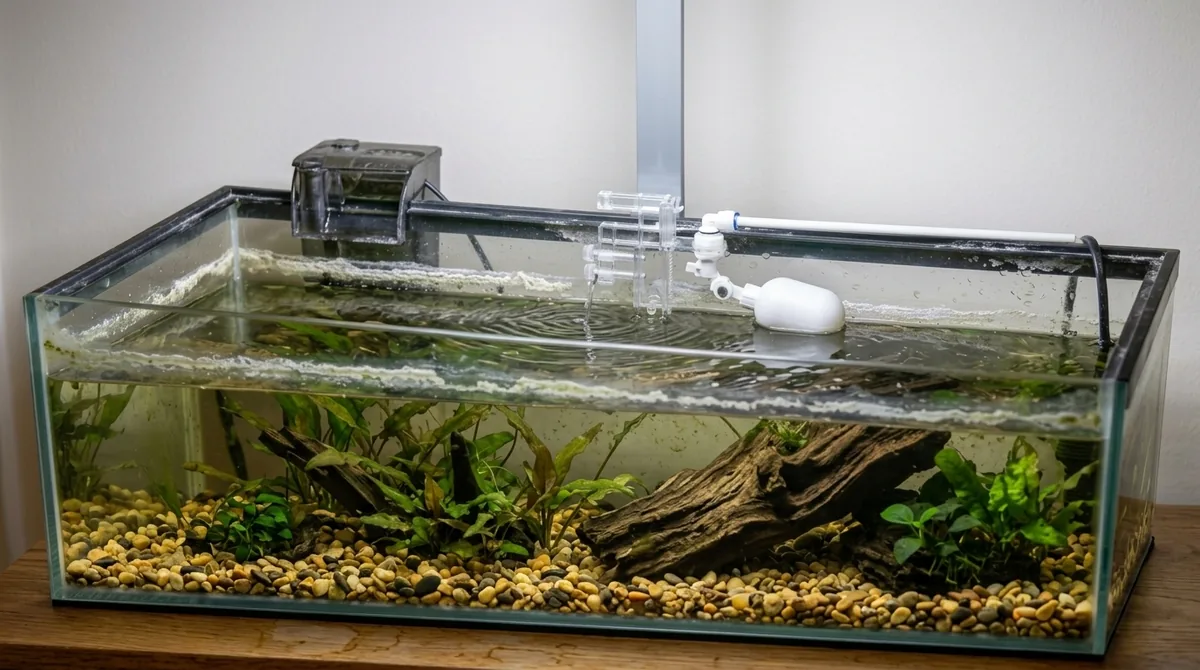
Topping Off
Isn't a Water Change
Replacing evaporated water keeps the tank full. It doesn't do what a water change does.
Water evaporates, the level drops, and refilling it feels like ordinary tank care. It looks like maintenance, and in one narrow sense it is — but it's quietly a different task than the one it resembles.
This guide explains what topping off actually does, why it can hide a slow buildup rather than prevent one, and how the two routines are meant to work together instead of substituting for each other.
Topping off feels like maintenance.
It isn't the same maintenance.
Water evaporates from every open tank. The level drops over days, and refilling it back up feels like exactly the kind of small, responsible habit a good keeper keeps. The tank looks full again, so it feels taken care of.
That feeling is reasonable, but it's answering the wrong question. Topping off restores volume. A water change restores volume too, but it also does something topping off never does. It exports whatever has built up in the water and replaces it with something cleaner.
Mixing the two up isn't a mistake exactly. It's more that the tank gives no obvious signal that they're different jobs. Both involve pouring water in. Only one of them removes anything first.
A water change removes some volume of old, used water before adding anything back. Topping off only adds. If nothing came out first, nothing was exported — the level went back up, but the water itself didn't change.
It dilutes concentration.
It doesn't remove waste.
When water evaporates, only the water itself leaves. Everything dissolved in it — minerals, nitrate, tannins, anything else — stays behind in a smaller volume. That means it gets more concentrated, even though nothing new was added to the tank.
Topping off with plain water dilutes that concentration back down partway, since the new water is starting from zero on all of it. This can look like an improvement on a test kit, but the actual mass of nitrate or minerals in the tank hasn't gone anywhere. It's just spread through slightly more water again.
A real water change works differently. Removing a portion of the existing water physically takes some of that dissolved buildup out of the tank entirely, before any new water goes back in. That's the step topping off skips.
"Topping off answers 'is the tank full,' not 'is the water clean.' Those are different questions, and only one of them is what a water change is actually for."
A tank can look stable
while quietly getting worse.
A keeper who tops off faithfully every few days is genuinely doing something, and it's easy to mistake that consistency for the whole job. The tank stays full, the routine feels maintained, and there's no obvious moment where anything looks neglected.
Meanwhile, the real water change schedule can quietly slip — the same drift capacity creep describes. Nitrate and hardness can climb steadily underneath that apparent stability. Topping off doesn't cause this, but it can mask it, since the tank never looks obviously low or neglected in between.
This is exactly the kind of routine that feels active without doing the specific thing it needs to do. Diligence in one task doesn't substitute for a different task that got missed.
A stable water level says nothing about how long it's been since old water was actually removed. Track the water change date separately from how the tank looks, especially in a setup that evaporates quickly.
Top off between changes.
Don't let it replace them.
Topping off is genuinely useful, and often necessary between water changes, especially in a tank that evaporates quickly. It just needs to sit alongside the water change schedule, not stand in for it.
The two routines have different rhythms and different jobs. Top off whenever the level noticeably drops, as often as that requires. Keep the water change schedule on its own separate tracking, regardless of how full the tank happens to look on any given day.
If it's ever unclear whether the real schedule has slipped, a nitrate test settles it directly. A tank that's been topped off faithfully but not truly changed in a while will usually show it, well before anything looks visibly wrong.
"The tank doesn't need you to keep it full. It needs you to keep exporting what builds up — and staying full is not the same as doing that."