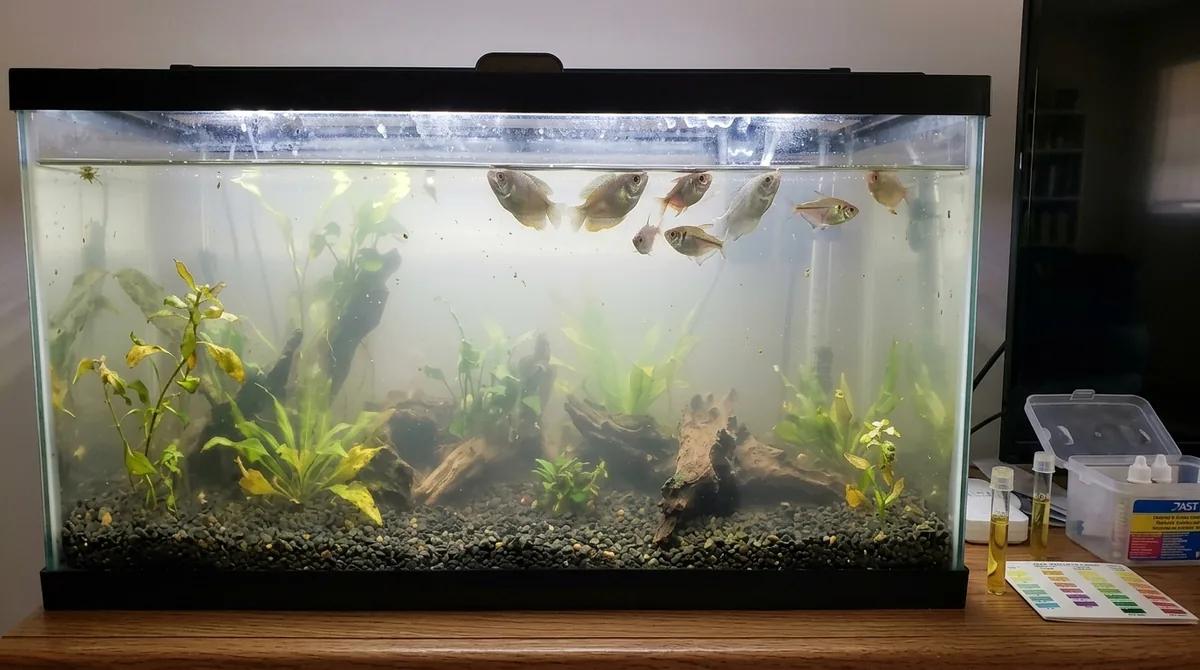
When the Tank
Crashes
What to do, what to feel, and what to decide.
You come home to find fish on the surface. Or you wake up and the water has turned opaque overnight. Or you notice the fish are all at the bottom, barely moving. The tank crashed. In the first few minutes, the instinct is to act — change the water, add something, fix something. But the first step is to read what happened.
This guide covers the immediate response to a crash, how to assess whether the tank is recoverable, and how to read a crash as information rather than catastrophe. For those who need it, it also covers how to process the grief of losing fish.
The first thirty minutes
In the first thirty minutes, two things matter: stabilise what is survivable, and do not add to the disruption. Test ammonia, nitrite, and if possible pH. These three numbers tell you what kind of crash this is. High ammonia (above 2 ppm) or detectable nitrite means the biological system has failed: the bacterial colony is overwhelmed or absent. Low pH with high CO2 is a different crisis from high ammonia with zero CO2. Understanding the type of crash shapes the response.
A 20–25% water change with dechlorinated, temperature-matched water is the safest universal first action. It dilutes whatever is elevated without shocking the system further. Do not do a large emergency change (50%+) unless ammonia is above 4 ppm or pH has dropped below 6.5; large rapid changes are a second shock layered on the first.
Remove dead or clearly dying fish, since decomposing bodies add to the ammonia load. Move surviving fish only if you have a suitable emergency container with dechlorinated water; the stress of netting and transfer may be greater than the stress of remaining in the crash tank during recovery.
Hold the first water change. Test again in two hours. The trend is more useful than the single reading.
"In a crash, the instinct is to act. The aligned response is to read — and act on what the reading says, not on what the panic suggests."
What caused it
Crashes have recognisable patterns. Knowing which pattern occurred guides both the immediate response and the longer recovery.
Ammonia spike from filter failure or cleaning: the bacterial colony was disrupted. The filter ran dry, was cleaned with tap water, or the power was out for more than 24 hours. Ammonia rises sharply over 24–48 hours. The tank may have appeared fine until it didn't.
New tank syndrome in an established tank: a large water change, medication course, or significant filter disturbance partially re-cycled the tank. The colony was smaller than the load, and the remaining load tipped it.
Overstocking tipping point: a tank that had been gradually adding fish finally exceeded the colony's processing capacity. The crash appears sudden but was the last step of a long drift.
Disease cascade: a disease introduced by new arrivals suppressed fish immune function, which triggered secondary bacterial infections, which raised ammonia from gill damage and decomposition.
Chemical poisoning: cleaning products near the tank, a treated wood or decor introduction, or a CO2 overdose. No biological recovery is possible until the chemical is removed or diluted.
Identifying the type matters because the response to a chemical crash is different from the response to an ammonia crash. Treating one with the other's protocol can accelerate the failure.
Is it recoverable
Most crashes are recoverable given sufficient time and consistent response. The question is whether the biology can re-establish faster than the remaining survivors can tolerate continued stress.
The factors that favour recovery: the bacterial colony was partially disrupted, not eliminated (the filter was running throughout, even if overwhelmed); there are surviving fish that are not in severe distress; ammonia, while elevated, is below 4 ppm and trending down after water changes; the cause has been identified and addressed.
The factors that complicate recovery: the filter ran dry or was replaced entirely, so the colony must rebuild from scratch, which takes weeks; multiple species died and the remaining bioload dropped suddenly, meaning the new balance will re-establish at a different setpoint; the cause was chemical and requires full water changes to eliminate; surviving fish are severely stressed with clamped fins, surface breathing, and not responding to food.
If the cause was chemical or the filter colony was completely eliminated, the tank will need to be managed like a new cycle for three to six weeks. Ammonia and nitrite will rise and fall before the colony re-establishes. This is survivable with consistent water changes and patience. Restarting versus recovering is a decision about the surviving fish, the keeper's capacity for intensive management, and honest assessment of what the tank can do now.
A tank that has crashed can rebuild. The past state doesn't determine the future state. The crash is information: it reveals what the previous setup wasn't sustaining. Rebuilding is the opportunity to create something that can actually be sustained.
A crash pushes an established tank back toward early-stage behaviour: unstable parameters, bacteria struggling to keep pace, fish under acute stress. Unlike a deliberate reset, this isn't a keeper decision; it happens to the system. Recognising it as a step backward, rather than a unique emergency requiring novel solutions, helps. The response follows the same logic as building a new cycle, adapted for a system that already has some established biology and an experienced keeper at the helm.
Not all phase transitions represent failure. A keeper may deliberately reset a system: to treat a persistent illness, reconfigure a setup, or start a new cycle after a crash. That's different from a crash-driven regression: a reset is a keeper decision, not a system breakdown. The tank moves through its early stage again, subject to the same developmental arc, but the keeper's accumulated knowledge shapes how the new cycle is managed.
What the crash is saying
A crash is rarely a completely random event. In most cases, looking backward reveals a series of signals the tank had been giving that did not cross the threshold of visible crisis until the crash occurred. Parameters that were stable but elevated. Fish that were not thriving but not obviously failing. Filter flow that had gradually decreased. Feeding that had increased incrementally. A disease that was treated but produced residual stress that was never fully cleared.
The crash reads as sudden because the visible threshold was crossed suddenly. The conditions that produced it were often weeks or months in development.
After the immediate crisis has stabilised, the more useful question isn't "how do I prevent this from happening again" — it's "what was the tank saying before this happened that I didn't read clearly enough?" Call it forensic ecology, not self-blame; it's what makes the next round of keeping more attuned.
Every experienced keeper has lost fish to a crash. The ones who learn from it are not the ones who beat themselves up; they are the ones who read the crash as information.
"The crash is the loudest signal a tank ever gives. The real question isn't how to silence it — it's what the tank was trying to say."
What you actually witnessed — the sudden die-off, the ammonia spike — was the end of a sequence, not the start of one. Somewhere before it were the missed signals and the slow drift that made the crash possible. Rebuilding well means finding that earlier point, not just replaying the ending in your head.
The loss
Losing fish in a crash is a grief that is often not acknowledged because fish are not always treated as animals that merit grief. But keepers who have cared for a tank for months or years have watched particular fish grow, develop personalities, establish relationships with other fish. Losing them to a crash can produce genuine sadness, guilt, and a questioning of whether to continue. These responses are valid. Caring for living animals involves their deaths. The crash accelerates that process and takes away the gradual and natural arc.
There is no fixed protocol for processing this. Some keepers take a week before re-establishing the tank. Some find that the work of rebuilding — the careful water changes, the daily testing, the gradual return of biology — is itself a process of meaning-making. Some decide the crash was the signal to simplify: fewer fish, a lower-maintenance approach, a different relationship with the hobby. None of these are failures. They are the Keeper Rhythm responding to its own experience and adjusting accordingly.
Aquatic Rhythm is built on the observation that keepers are part of the system. What happens to the keeper — the loss, the grief, the reassessment — is part of what the tank produces and what it teaches. Reading the crash means reading what it asked of you as well as what it asked of the biology.
If you're reading this in the aftermath of a crash: how hard it hit you says something good about you, not something bad. It's the same attentiveness that made you notice things, care about the animals, and build something over months. That doesn't disappear because of a crash. It just hurts right now. Whatever you decide about the tank next, you already know more about aquatic systems than you did before this. That knowledge stays.