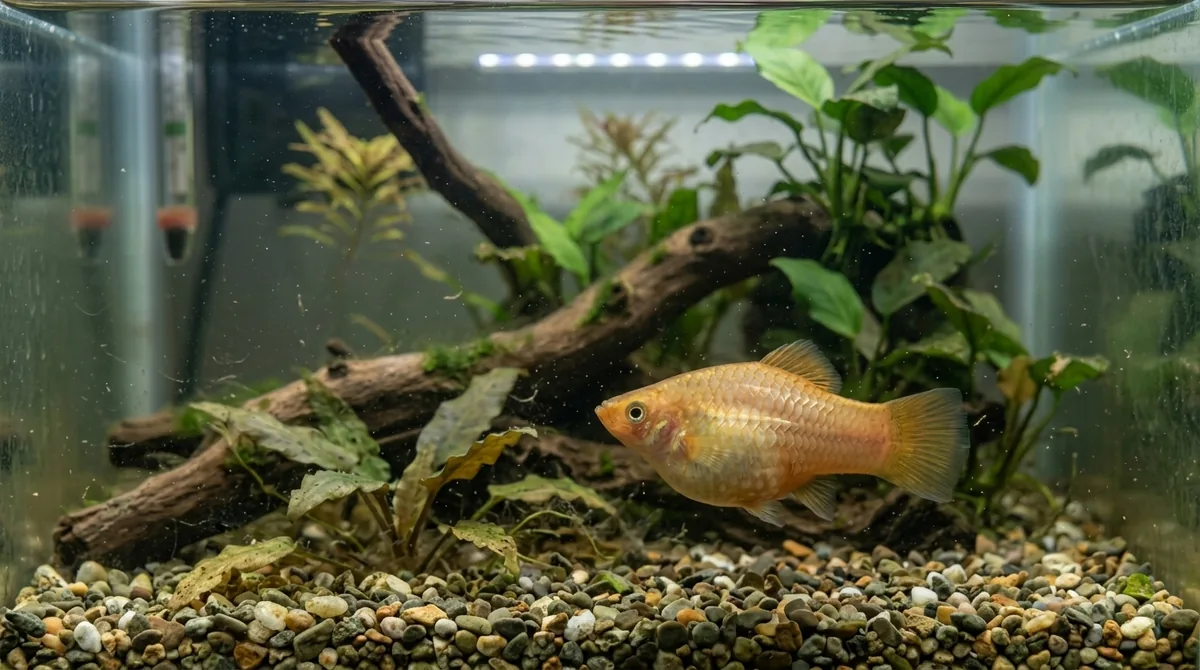
Dropsy
When Treatment Isn't Working
Raised scales aren't the disease itself — they're a sign of something bigger.
A fish with a swollen belly and scales standing out from the body — the look often called "pinecone" — is describing something happening inside it, not on the surface. That look is dropsy, and it isn't a disease of its own. It's the visible result of severe fluid retention, usually driven by kidney failure, systemic infection, or organ damage that's already been building for some time.
This one covers what dropsy is actually telling you, why early and late cases call for genuinely different responses, and what to do once a fish keeps relapsing through every treatment tried in the right order — including the option most guides leave out entirely.
A symptom, not a diagnosis
Dropsy is fluid accumulating in the body cavity and under the scales faster than a fish's kidneys can process it. The scales stand outward because the tissue underneath is swelling, not because anything is wrong with the scales themselves. It's usually a downstream effect of kidney failure, a systemic bacterial infection, or in some cases mycobacteriosis, rather than a specific illness with one specific cause. That's why treatment advice for dropsy varies so much between sources: they're often describing different underlying triggers that happen to produce the same visible swelling.
By the time scales are visibly raised, the underlying process has usually been running for a while. Dropsy has a reputation for poor outcomes partly because it's a late-stage sign, not an early-warning one. The internal damage driving the swelling was already underway before the swelling itself became visible enough to notice during a normal check.
That doesn't make the symptom meaningless. It confirms the severity of what's happening internally. In early cases — mild swelling, scales still mostly flat — it's worth investigating the trigger where possible. Look at recent water quality issues, a new fish added without quarantine, or other fish in the same tank showing early signs. Any of those points toward a contagious cause rather than an isolated organ problem.
Lethargy, faded colour, and reduced appetite often precede visible dropsy by days, but rarely get connected to it until the swelling itself appears. By then the process has usually had a head start that no treatment schedule can fully recover.
Two very different starting points
Early dropsy looks like this: mild swelling, scales still mostly flat against the body, the fish still eating and reasonably responsive. That's the case where a structured treatment attempt is reasonable. That typically means an appropriate antibacterial course for the likely cause, an Epsom salt bath to help draw fluid out osmotically, and immaculate water quality throughout. Run the combination for a defined period, commonly around 7 to 10 days. Watch closely during that window for any real improvement, rather than just the absence of further decline.
Late dropsy looks different in a way that matters. Full pinecone scales, a curved spine, a fish that has stopped eating and can barely maintain its position in the water. At this stage, sources consistently describe the internal organ damage as extensive, and recovery as rare regardless of what treatment is attempted. This isn't a claim that trying is pointless in principle — it's a description of how the odds actually sit once the disease has reached this point.
The distinction matters because treating a late-stage fish with the same urgency and hope as an early-stage one can extend the process without meaningfully changing where it ends. These are two different situations, and they call for two different responses — not the same response, tried harder.
"Dropsy doesn't test how hard a treatment is tried. It tests how much organ function was still there before the treatment started."
A repeated relapse is also a reading
A fish can improve briefly on treatment and then relapse, or fail to respond at all to a correctly run course despite good water quality and an appropriate medication. That's communicating something as clearly as any other symptom this site usually covers — it's simply a harder one to sit with. Reading over rule-following is the whole approach here, and a repeated relapse after correct treatment is a reading. It isn't a personal failure of effort.
Veterinary and animal-welfare sources are fairly direct about the next step once a fish has reached advanced dropsy. At that stage — pinecone scales, no appetite, minimal movement, no meaningful response to appropriate treatment — euthanasia is described as a legitimate and often kinder option. It isn't a last-resort admission of defeat.
What follows isn't a substitute for that reading. It's what to do once the reading has already pointed there, so it can be carried out without adding more uncertainty to an already difficult moment.
No real improvement after a full, correctly run course of an appropriate treatment. The fish worsening despite water parameters staying good throughout. The fish no longer eating or no longer able to maintain its position without effort. None of these are failures on the keeper's part — they're the reading itself.
A short, deliberate ending — done correctly
The method most consistently recommended for euthanising a fish at home is an overdose of clove oil (eugenol) dissolved in the water. Clove oil doesn't dissolve directly in water, so mix it into a small amount of warm water first. Add that mixture slowly to the fish's container over roughly five minutes rather than all at once. Adding it too quickly is itself an added stress in a moment that doesn't need one.
Confirm death by watching for gill (opercular) movement, and don't move or otherwise disturb the fish until at least 30 minutes have passed with no movement at all. Older advice recommending an ice bath alone is now treated more cautiously by more recent welfare research. That research has found the loss of consciousness can take considerably longer than expected, and that direct contact with ice itself may cause pain before unconsciousness sets in. Where an aquatic veterinarian is reachable, calling first is worth it — their direct guidance takes precedence over any general reference, including this one.
None of this makes the decision itself easier, and it isn't meant to. What it removes is a second, avoidable layer of harm: doing it in a way that causes more suffering than watching and waiting would have. That harm is easy to add without meaning to, simply because nobody had explained what the alternative actually looks like.
This procedure reflects guidance from the AVMA Guidelines for the Euthanasia of Animals (2020 Edition), the RSPCA aquarium fish knowledgebase, and the UK Ornamental Aquatic Trade Association (OATA). None of it is this site's own judgement. All three explicitly recommend seeking advice from a veterinarian with aquatic experience where one is available, ahead of any home method.